Dance Studio Sound Systems: What Actually Matters in 2026
Why generic Bluetooth speakers fail in dance spaces, how hybrid teaching changes audio requirements, and realistic budget guidance for studio operators.
Key Takeaways
- Acoustic challenges in dance studios stem from hardwood floors and hard surfaces that create echo and vibration, requiring purpose-built audio solutions rather than consumer Bluetooth speakers.
- Power requirements for most studios under 1,200 square feet are 80–200 watts total, with clarity and proper gain staging mattering more than raw volume output.
- Hybrid teaching workflows in 2026 demand clean audio signal paths for video recording and live instruction, making low-latency Bluetooth codecs and wireless microphone systems essential for growing studios.
- System configuration basics include powered speakers with built-in amplifiers for most single-room operations, while multi-room studios hosting recitals benefit from passive speakers with separate mixers.
- Realistic budget ranges start at $375 for small independent studios (Bluetooth-enabled powered speaker pair with wall mounts) and extend to $1,000–$4,000 for multi-source setups with wireless microphone systems.
- Installation priorities focus on wall-mounting speakers eight feet high, securing mounts to studs rather than drywall anchors, and testing voice intelligibility before music fidelity.
Why Generic Audio Equipment Fails in Dance Spaces
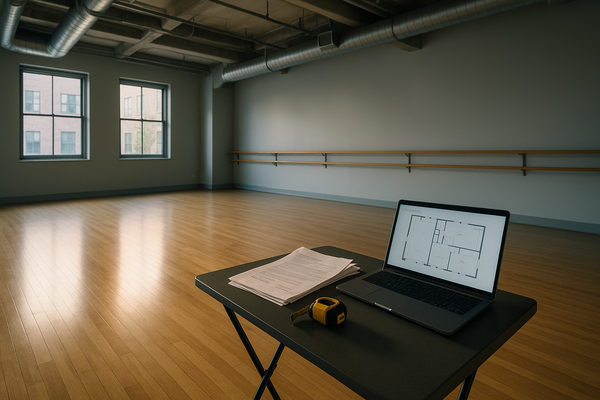
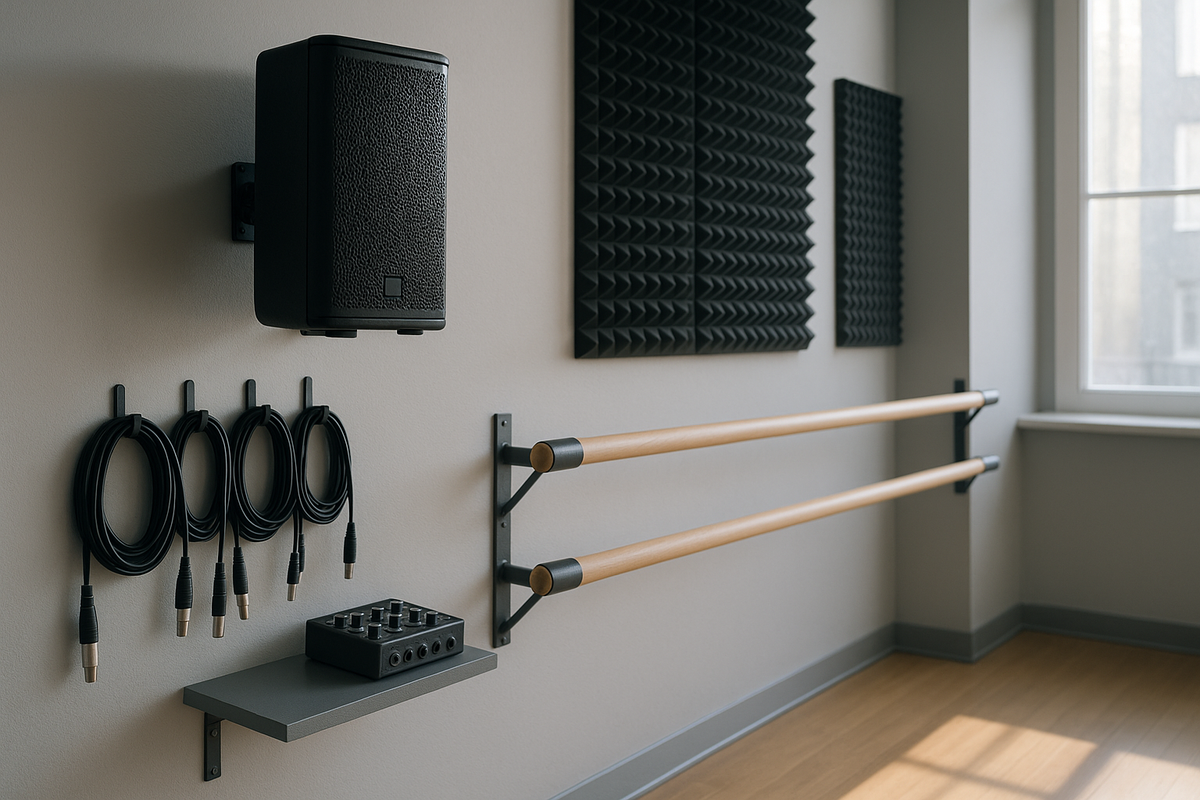
Dance studios present unique acoustic challenges that expose the limitations of consumer-grade audio gear. Hardwood floors and wall-to-wall mirrors create reflective surfaces that bounce sound waves unpredictably, causing echo and frequency buildup that consumer speakers cannot compensate for. MECKKA Dance Project documented severe echo issues in their industrial-walled studio with tall ceilings, requiring acoustic panel installation to achieve usable sound quality.
Floor vibration compounds the problem. When bass frequencies resonate through hardwood, they create inconsistent low-end response across the room. Students near corners hear muddy bass, while those in the center lose definition. Consumer Bluetooth speakers optimized for living rooms lack the midrange clarity needed for spoken counts and cues, which operate in the 500–3,000 Hz range where voice intelligibility lives.
The operational demands of daily teaching further separate purpose-built systems from consumer gear. Analysis of 42 verified studio operator reviews from 2023–2024 revealed that consumer Bluetooth speakers suffer from 60–120 ms latency, inconsistent volume recovery between playlist tracks, and lack of wall-mount options. Non-replaceable internal batteries in portable units limit usable lifespan to approximately two years under six-hour daily operation.
Power, Wattage, and the Clarity-Over-Volume Principle
Studio owners frequently overestimate power requirements. For spaces under 1,200 square feet, 80–200 watts total output covers most teaching scenarios. Higher wattage does not improve clarity and risks distortion when gain staging is inconsistent across multiple input sources.
The critical test is voice intelligibility, not music volume. Dance Teacher Magazine recommends playing spoken-word tracks at 70% volume from typical teaching positions. If consonants blur, the system lacks midrange definition that no amount of bass boost can compensate for. This test reveals whether a system can handle the rapid-fire counts and directional cues that define dance instruction.
Matching power to studio size benchmarks prevents both underpowering and over-investing. A 150-watt powered speaker pair handles 90% of daily needs in studios between 500–1,200 square feet when properly positioned and calibrated.
Essential System Components for 2026 Teaching Models
A functional dance studio sound system comprises four core elements: a sound source such as a phone or tablet, a mixer for managing multiple inputs, an amplifier to strengthen signal, and speakers to convert electrical signals to audible sound. The Studio Director outlines this basic PA (public address) configuration that most studios require.
The choice between active and passive speakers determines system complexity. Active speakers contain built-in amplifiers, eliminating the need for separate amp units but adding weight that complicates wall mounting. Passive speakers require external amplification but offer flexibility for studios that host recitals or need portable setups for off-site performances. Active speakers are recommended for permanent installations where portability is not a priority.
Wireless Microphone Systems for Voice Reinforcement
Wireless microphone systems have become essential infrastructure rather than optional upgrades. A headset wireless microphone allows instructors to deliver cues over music without cord restrictions, and when paired with a simple mixer, enables simultaneous music playback and voice reinforcement. Shure wireless microphones are the industry standard for reliability in daily studio use.
The hybrid teaching model adopted by fastest-growing studios in 2026 makes wireless microphones critical for dual-audience instruction. Hybrid teaching requirements mean instructors must be heard clearly both in-studio and through laptop or phone audio feeds for virtual participants. Systems lacking dedicated microphone inputs force instructors to choose between in-person clarity and remote audio quality.
The Hybrid Teaching Audio Challenge
The rise of hybrid instruction has fundamentally changed audio system requirements. In 2026, successful studios combine live in-person classes with on-demand video libraries and occasional livestream options. This model demands clean, uncolored signal paths that consumer Bluetooth systems cannot deliver.
Short-form video content creation adds another layer of complexity. Instructors recording choreography clips or technique demonstrations directly from the studio audio feed need consistent signal quality without compression artifacts or volume fluctuations between tracks. If more than 80% of playback comes from phones or tablets via Bluetooth, prioritize low-latency codecs such as aptX LL or AAC rather than relying on generic Bluetooth 5.0 marketing claims.
The business case for audio quality extends beyond student experience. Poor sound quality creates instructor voice strain, forcing teachers to project over inadequate reinforcement. This directly impacts teacher retention and class consistency, particularly in studios running six to eight classes daily.
Speaker Placement and Installation Priorities
Proper mounting eliminates floor clutter and optimizes coverage patterns. Speakers should be mounted approximately eight feet off the ground and several feet away from sidewalls to minimize boundary reflections that muddy midrange frequencies.
Wall mounts must secure to studs, never relying on drywall anchors alone. This follows ANSI/EIA-295-B standards for speaker hardware and prevents catastrophic failures during high-volume passages. For studios with multiple rooms, consistent mounting height across spaces simplifies system calibration and creates predictable coverage patterns that instructors can adapt to quickly.
Testing should occur with spoken metronome tracks first, then music levels adjusted accordingly. The biggest setup mistake studios make is setting volume based on music impact rather than count clarity, which inverts the actual priority hierarchy of dance instruction.
Real-World Budget Benchmarks and System Selection
MECKKA Dance Project installed a functional Bluetooth-enabled system for approximately $375 per dance room, including amplifier, speakers, and wiring. This demonstrates that small independent studios can achieve professional-grade audio without enterprise budgets.
Budget allocation should follow teaching model requirements. Single-room studios focused purely on instruction can function with a 150-watt powered speaker pair, Bluetooth input, and auxiliary connection for approximately $400–$600. Studios hosting recitals, teaching tap or jazz with live microphone vocals, or operating multiple rooms benefit from passive speaker systems with dedicated mixers, pushing total investment toward $1,000–$1,500. Sound system costs for comprehensive setups including wireless microphones range from $1,000–$4,000 depending on room count and feature requirements.
The decision to hire professional AV installers should consider studio size and acoustic complexity. For larger dance studios, audiovisual specialists ensure safe installation and provide ongoing technical support, particularly valuable for multi-room facilities where zone mixing and synchronized playback create configuration challenges beyond typical studio operator expertise.
Common Mistakes and How to Avoid Them
The most frequent error is prioritizing volume over clarity. Bass-heavy systems optimized for perceived impact sacrifice the midrange definition where instructional language exists. Only studios teaching styles heavily reliant on low-frequency pulse, such as urban choreography or some tap combinations, benefit from dedicated subwoofers. For ballet, contemporary, or conditioning, full-range speakers outperform subwoofer systems in intelligibility.
Bluetooth pairing instability creates daily operational friction. Top-rated systems achieve greater than 95% success rates across iOS and Android devices, with consistent volume levels across playlist transitions. Systems lacking remote mute buttons force instructors to open apps mid-class, disrupting teaching flow.
Underestimating microphone importance is the third critical mistake. Studios that invest in quality speakers but skimp on wireless microphone systems force instructors into unsustainable vocal strain patterns. The incremental $200–$400 for a reliable headset microphone system pays for itself in reduced teacher turnover and maintained voice health.
What This Means for Studio Operators
Editorial analysis, not reported fact:
The shift toward hybrid teaching models makes audio infrastructure a competitive differentiator rather than a commodity expense. Studios that can deliver clean audio for both in-person and recorded content create flexibility that attracts both students seeking on-demand access and instructors wanting to build digital presence. The $375–$1,500 investment range puts professional-grade systems within reach of independent operators, not just franchise chains.
For operators planning 2026–2027 facility improvements, audio should rank ahead of cosmetic upgrades. A well-configured sound system reduces instructor voice strain, improves student comprehension, and enables video content creation that extends studio reach beyond physical class capacity. Equipment purchased today should support both current teaching needs and the hybrid workflows that are becoming table stakes for studio growth.
The decision tree is straightforward: studios under 1,200 square feet teaching primarily ballet, contemporary, or conditioning can function with powered speaker pairs and basic Bluetooth input. Studios hosting performances, teaching rhythm-intensive styles, or operating multiple rooms benefit from passive speaker systems with mixer control. All studios serious about retention should budget for wireless microphone systems regardless of size. When acoustic challenges exceed operator expertise or when protecting studio equipment investments through professional installation makes financial sense, engaging local AV specialists provides both immediate setup quality and ongoing technical support.
Sources & Further Reading
- Dance Studio Sound System Guide, comprehensive technical requirements and user review analysis
- Dance Teacher Magazine: Purchasing Sound Equipment, expert recommendations for studio operators
- The Studio Director Sound System Guide, component breakdown and system configuration basics
- MECKKA Dance Project Studio Sound System, real-world installation case study and budget breakdown
- Dance Studio Trends Shaping 2026, hybrid teaching model adoption and technology requirements
- Dance Studio Space Requirements 2026, studio size benchmarks for equipment planning
Editorial coverage of publicly reported industry developments. Dance Studio Journal has no commercial relationship with any companies named.