Referral Programs That Actually Bring in New Dance Families
Formalized referral programs deliver sub-$25 acquisition costs and 40-55% conversion rates, yet most studios fail to track or optimize them. Here's how to fix that.
Key Takeaways
- Referral programs deliver the lowest acquisition cost and highest retention: Studios can land new student acquisition under $25 per member through formalized referrals, compared to $30-$100 for optimized social ads and $200-$400 for boosted posts. Referred students retain 18% longer and show 37% higher lifetime value.
- Two-sided incentive structures convert 40-55% of referrals: The most effective programs reward both the referring family (typically $25-$50 tuition credit) and the new student (discounted or free first month), framing the referral as a gift rather than a sales pitch.
- Most studios fail to track referral performance: Without registration form fields asking "How did you hear about us?" or unique referral codes, studios cannot measure conversion rates, time-to-enroll, or the percentage of new enrollments driven by referrals.
- Kids and adult programs require different referral mechanics: Parent-to-parent referrals dominate kids acquisition through local mom groups and friend networks, while adult programs need digital sharing tools and social proof mechanisms aligned with Instagram and TikTok discovery patterns.
- Passive word-of-mouth underperforms formalized programs by 15-30%: Studios relying on informal recommendations miss systematic opportunities. Formalized programs with clear incentives, promotion across multiple touchpoints, and celebration of top referrers generate 15-30% of all new enrollments.
Why Most Dance Studios Leave Referral Revenue on the Table
Word-of-mouth recommendations drive 65% of all new business, yet most dance studios treat referrals as hope-based rather than systems-based revenue. The economic case is clear: a referral program costs 5-7 times less to build than acquiring customers through traditional marketing methods, and a well-structured referral program can land total acquisition cost under $25 per new member.
The retention advantage compounds this value. Members who join through a friend's referral have 37% higher lifetime value than members acquired through paid advertising, staying an average of 15.6 months versus 10.8 months for ad-sourced students. Despite these benchmarks, studios fail to formalize referral structures, leaving money on the table during a year when enrollment is up nearly 10% year-over-year but retention economics demand lower-cost acquisition channels.
Program Structures That Convert at 40-55%
Dance referrals convert at 40-55% compared to 10-15% for advertising leads, but conversion depends on program design. The two-sided incentive model dominates successful implementations: the most effective rewards benefit the referring family and the new student, with a standard model offering the current family a tuition credit and a similar discount to the new family. This structure makes the referrer feel like they are giving their friend a gift, not selling them.
Real-world examples validate this approach. Jen Philipp Shebetka's Extensions Dance Academy offers a $10 gift certificate to the dancewear shop and an entry into a drawing for a month of free tuition for each referral, generating 15 new students the first year and 21 last year in just August and September. Similarly, Will Tijerina at Dance 360 in Orlando ran a bring-a-friend week with a $35 tuition credit for referring families, adding 25 kids in one week.
Tiered Reward Options Beyond Tuition Credits
Studios that diversify rewards see broader participation. Incentives include free classes, discounts on tuition, one-on-one sessions, gift cards for local business partners, social events or social media spotlights for top referrers, and studio merchandise. One model offers a $5 credit per month to the referring student, up to a $50 limit, if the new student remains enrolled for 10 months, creating a retention incentive alongside acquisition.
A year-end grand prize drawing using the names of families who referred students throughout the year, with prizes like a free week at summer camp worth $200-$300, ensures the winning student stays enrolled for future programs while encouraging families to accumulate multiple referrals. Even a token thank-you, like free studio merch or a social media shout-out, can reinforce referral behavior.
The Measurement Gap Costing Studios Revenue
The highest-converting channel in the industry remains unmeasured at most studios. The most significant barrier to effective budget allocation is not knowing what actually works, with most studio owners failing to use management software to track referral data effectively or measure acquisition costs by channel. Without referral attribution challenges addressed, studios cannot calculate return on incentive investment or optimize reward structures.
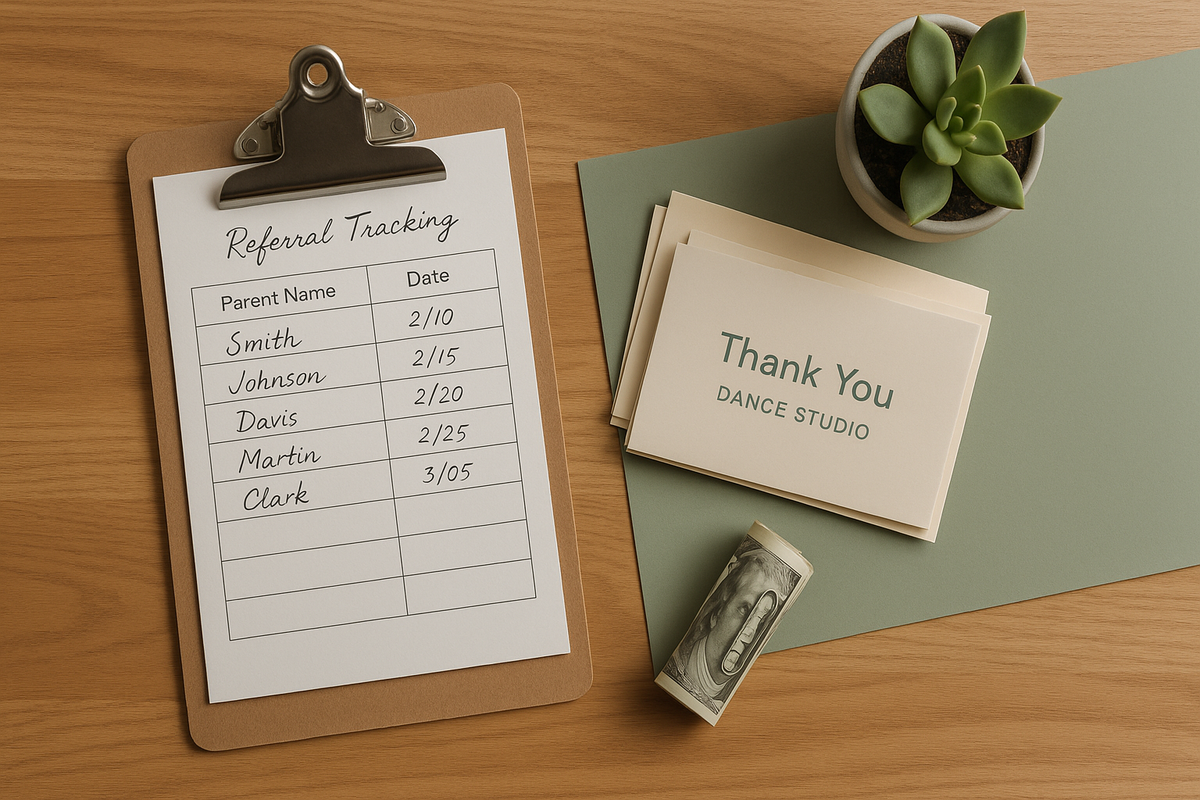
Basic tracking infrastructure starts with registration forms. Studios should add a field to online registration asking "How did you hear about our dance studio?" to capture referral sources. More sophisticated systems use unique referral codes or links assigned to each family, allowing automatic crediting when a new student registers using that link.
Three Metrics That Matter
Studios should track the percentage of new enrollments from referrals, redemption rate, and time-to-enroll. These metrics reveal whether a program is generating volume, whether incentives motivate action, and how referral velocity compares to paid channels. Studios averaging 15-30% of new enrollments from referrals can benchmark performance and identify underperforming segments.
Kids Versus Adults: Different Mechanics for Different Buyers
Referral programs cannot use identical mechanics across demographics. Kids program acquisition happens through local mom Facebook groups, Google Maps, and friend referral, while adults discover studios via Instagram, TikTok, and local "things to do" lists. This distinction requires different referral activation strategies.
For kids programs, parent-to-parent referral is consistently the highest-conversion acquisition channel, with typical structures offering referring families $25-$50 tuition credits and referred families a free or discounted first month. Physical referral cards for parents to hand out at school pickup or playdates reduce friction. Adult programs need digital-first mechanics: shareable links for Instagram Stories, branded hashtags, and mobile-optimized referral landing pages that match the social discovery pattern.
Five Mistakes That Kill Referral Program Performance
Studios with underperforming referral programs share common design and execution failures. The first is invisibility: studios must announce referral programs everywhere, mentioning them in newsletters, posting on social media, distributing flyers in the lobby, and having front desk staff mention them at drop-off and pick-up. One-time announcements generate one-time results.
The second mistake is vague or complicated incentives. Studios should not create complicated hoops to jump through, instead offering families simple referral cards to hand out or a unique digital link to share via email and social media. Multi-step redemption processes kill conversion regardless of reward value.
Product Quality Drives Referral Willingness
The third mistake is launching referral programs without addressing studio experience. For referrals to work, your dance studio has to be worth referring, with students and parents actively sharing only if they feel it's worth shouting about. No incentive compensates for poor instruction, inconsistent communication, or chaotic operations.
The fourth mistake is failing to celebrate referrers publicly. Celebrating referrers publicly, with permission, serves as a community-building tactic that deepens engagement beyond transactional rewards. Recognition on social media, in-studio signage highlighting top referrers, and shout-outs in newsletters reinforce the behavior and signal program legitimacy to other families.
The fifth mistake is treating referrals as separate from retention strategy. Referred fitness studio members have higher retention rates because they have a built-in accountability partner, making referral programs doubly valuable by acquiring new members and improving the referrer's retention simultaneously. Studios that isolate referral programs from onboarding, community events, and retention touchpoints miss this compounding effect.
What This Means for Studio Operators
Editorial analysis, not reported fact:
October 2026 presents unusual conditions for formalizing referral infrastructure. Enrollment is up industry-wide, but tighter retention funnels and increased competition for discretionary family spending mean studios cannot rely on passive word-of-mouth. The studios that will capture disproportionate referral volume are those that implement tracking before launching incentives, design two-sided rewards that make referring families feel generous rather than transactional, and promote referral programs across every touchpoint from registration confirmation emails to lobby signage.
For studios operating on thin margins, the 5-7x cost advantage of referrals versus traditional marketing represents the difference between profitable growth and break-even scale. Studios spending $200-$400 per new student on boosted social posts while leaving referral infrastructure informal are subsidizing Facebook's revenue at the expense of their own unit economics. A 14-day sprint offering "Refer 1 Family, Get a Free Month" with proper tracking can baseline current referral capacity and identify whether the constraint is incentive design, visibility, or product quality.
The kids-versus-adults distinction matters more in 2026 than in prior years, as adult enrollment surges and brings different decision-making patterns. Studios adding adult programming without adapting referral mechanics to digital sharing behaviors will underperform benchmarks. The investment required is minimal: mobile-optimized referral pages, shareable graphics sized for Instagram Stories, and unique tracking links take hours to implement but unlock an acquisition channel with 40-55% conversion rates and 37% higher lifetime value.
Sources & Further Reading
- Dance Marketing: Dance Studio Referral System, comprehensive guide to referral program structure and tracking mechanics
- Dance Teacher Magazine: Ask the Experts on Referral Programs, real studio case studies with enrollment numbers from Extensions Dance Academy and Dance 360
- Regulr: Referral Program Strategies for Fitness Studios, acquisition cost and lifetime value benchmarks for referral-sourced members
- Ensemble Schools: State of the Dance Studio Industry 2025-26, industry enrollment trends and retention context for October 2026
- Yoga Studio Insider: Marketing Budget Benchmarks 2026, referral attribution gaps and tracking best practices applicable to dance studios
- Creatively Disruptive: How to Encourage Referrals for Your Dance Studio, reward types and psychological foundations of referral program design
Editorial coverage of publicly reported industry developments and best practices. Dance Studio Journal has no commercial relationship with any companies, studios, or software providers named in this article.