Recital Season Staffing: Why Studios Need Extra Hands
Teacher hours jump 40-65% in final recital weeks. Here's how to staff costume changes, backstage coordination, and tech roles without burning out your core team.
Key Takeaways
- Teacher workload surges 40-65% in final weeks: Instructors who work 15 hours weekly in fall may jump to 25+ hours during May recital preparation, creating acute burnout risk as they add full run-throughs and stamina drills on top of regular teaching.
- Recital coordination requires a multi-role team: Studios need teachers, reception staff, costume assistants, photographers, volunteers, and venue personnel to manage hundreds of names, costume changes, music cues, and dressing room assignments across a single performance.
- Labor costs compound quickly: With teacher pay at $30 per hour and administrative staff at $19, employer payroll taxes and benefits add 15-25% on top of base wages, making temporary staffing a significant investment.
- Volunteer roles extend beyond logistics: Beyond setup and teardown, trained volunteers assist choreographers during rehearsals, coordinate quick costume changes backstage, and even provide dancer feedback, embedding themselves in the artistic fabric of the studio.
- Failure to confirm roles early triggers last-minute chaos: Studios that delay staff and volunteer assignments until the final week face underdeveloped systems, confusion among families, and preventable quality breakdowns during dress rehearsals and performance.
Why the Final Weeks Break Existing Staff
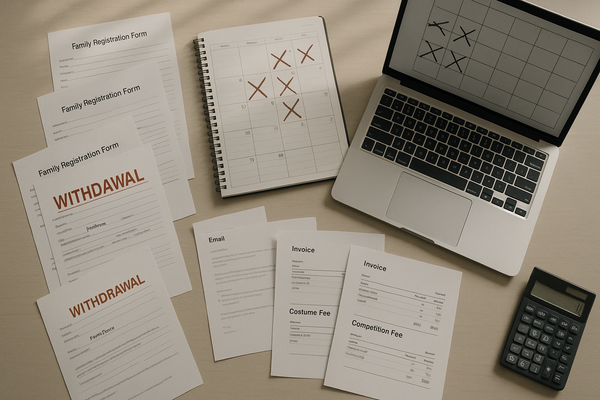
Recital season compresses months of preparation into a 4-6 week sprint where teaching, administrative, and production demands converge. One performance may involve hundreds of names, several rehearsal groups, costume deadlines, ticket payments, music files, and changing room assignments, all requiring real-time coordination across dispersed teams.
The performing arts sector runs notoriously lean. Arts professionals often have to master many roles to get the job done, with insufficient budget to employ people for all required tasks. This baseline scarcity collides with recital season's exponential complexity, leaving core staff overstretched. Even studios that plan early face inevitable time shortages as dance recital planning requires micro and macro management in a compressed timeframe.
The Teacher Burnout Curve
Instructors bear a double load during final weeks. They continue regular class schedules while layering in recital-specific rehearsals, increasing full run-throughs to build stamina and familiarity. Teachers report feeling more irritable with dancers or ready to give up after months of routine training culminate in a final push toward performance.
This pattern mirrors broader teacher burnout patterns documented across studio operations, where concentrated performance periods amplify stress. Studios that fail to redistribute workload or bring in temporary support risk losing instructors permanently once recital ends.
The Hidden Roster: Roles Beyond Teaching
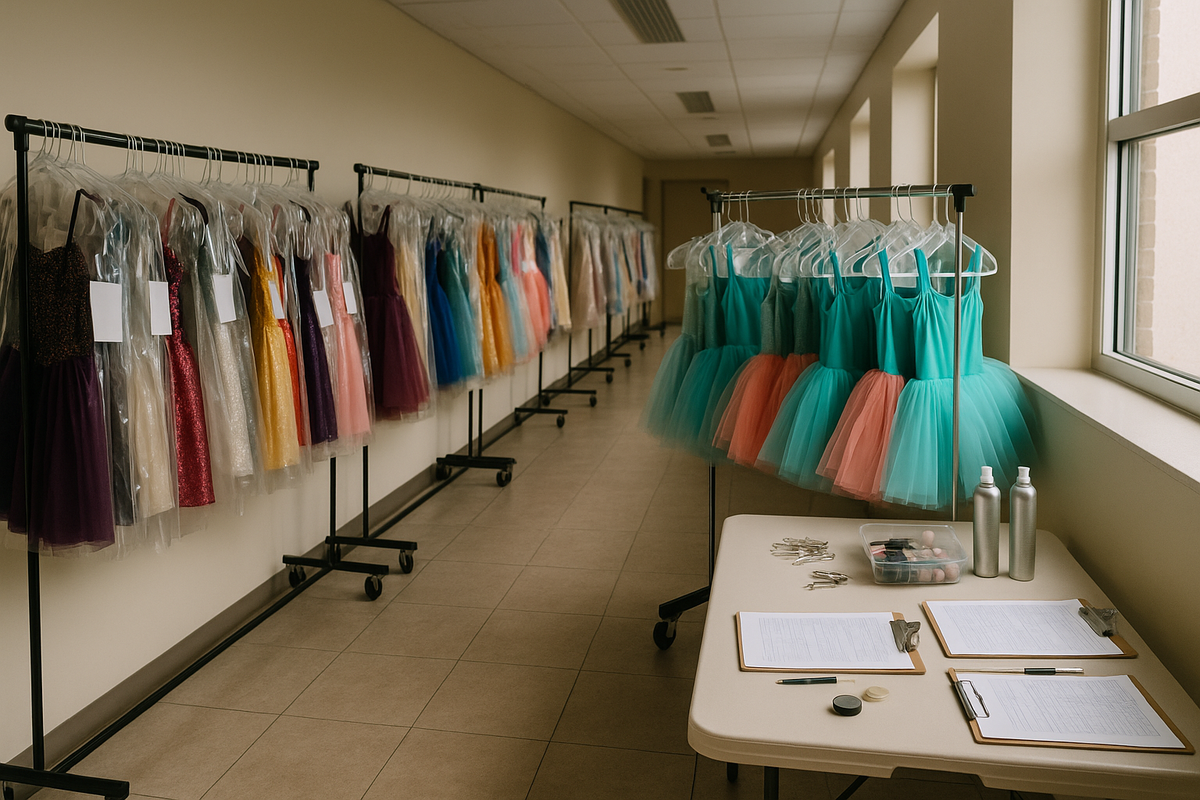
Recital preparation draws on teachers, reception staff, costume assistants, photographers, volunteers, and venue personnel. But the final weeks demand specialization beyond these broad categories. Studios need costume organizers who understand complex quick-change sequences, dressing room monitors who can manage dozens of young dancers simultaneously, and line leaders who coordinate precise entry and exit timing.
Hair and makeup coordination alone can require trained volunteers to apply stage makeup for 50-100 performers in a compressed backstage window. Tech crew for sound, lighting, and stage management operate independently of teaching staff, yet their work directly determines whether transitions feel seamless or chaotic. Parent volunteers handle setup, teardown, and crowd management, freeing paid staff to focus on performance-critical tasks.
Volunteer Contributions to Artistic Quality
Beyond administrative tasks, volunteers contribute to the artistic fabric of the studio by assisting choreographers during rehearsals, providing feedback to dancers, and even participating in performances. This integration requires early training and clear role definition. Studios that treat volunteers as last-minute gap-fillers miss the opportunity to build a knowledgeable support network that understands both the artistic vision and operational mechanics.
Effective volunteer programs also cultivate entrepreneurial skills, as participants gain exposure to budgeting, marketing, and event planning. For studios, this creates a talent pipeline for future administrative hires who already understand the business model and seasonal rhythm.
Confirming Roles Before the Chaos Begins
Studios must confirm staff and volunteer assignments well before the final countdown. Dance studio owners are busy running their studios, so preparing for recital season often gets pushed to the last minute, and this lack of preparation can lead to underdeveloped systems that confuse and discourage attendees.
Best practices include creating individual role profiles showing assigned duties with mobile access, allowing employees to review responsibilities between rooms or backstage areas. Studios should include photos of dancers and class costumes to help volunteers at lineup time, include maps of dressing room assignments and quick-change charts, and keep all materials in a binder or digital folder accessible to all staff and volunteers.
Hosting a full dress rehearsal at least one week before the recital allows studios to troubleshoot issues when there is still time to adjust. This is when understaffing becomes visible: if costume changes run long, if dancers miss cues, or if backstage communication breaks down, the studio can add targeted roles rather than scrambling on performance day.
The Economics of Temporary Staffing
With teacher pay at around $30 per hour and administrative staff at about $19, studios face real budget pressure when adding temporary help. Employer payroll taxes and benefits can add 15-25% on top of base wages, meaning a 10-hour temporary role at $19 per hour costs $237.50 fully loaded, not $190.
This cost structure makes volunteer coordination financially essential. Studios cannot afford to staff every recital role with paid employees, yet they also cannot rely solely on untrained volunteers for roles requiring technical expertise or legal responsibility. The solution lies in hybrid models: paid coordinators who manage trained volunteer teams, or part-time specialists hired specifically for recital season's compressed timeline.
Acknowledging when workloads increase and finding budgetary resources to accomplish the work in new ways—with external consulting resources, part-time staffing, or partnership opportunities—can have a big impact on keeping workloads manageable for team members. Studios that view recital staffing as a temporary surge investment rather than an ongoing labor expense can protect margins while preventing burnout.
Preventing Burnout Through Strategic Deployment
The gap between studios that thrive during recital season and those that collapse under pressure often comes down to deployment strategy. Maintaining service quality and family connection requires bandwidth, and for many owners, bandwidth is the one thing they cannot easily add through willpower alone.
Studios should cap instructor contact hours even during recital season, recognizing that preventing instructor burnout requires systemic limits rather than individual resilience. When regular teaching consumes 15 hours weekly, recital preparation should not push total contact hours above 20-22 without additional compensation or schedule relief elsewhere.
Administrative staff face similar constraints. The explosion of costume tracking, ticket sales, family communication, and venue coordination cannot fall to a single front-desk employee already managing daily operations. Studios exploring lean staffing operations through software automation during regular seasons must recognize that recital weeks demand the opposite: temporary staff expansion to handle non-automatable tasks like backstage coordination and live problem-solving.
What This Means for Studio Operators
Editorial analysis, not reported fact:
The studios navigating recital season successfully in 2026 are those that treat staffing as a variable cost tied to event intensity rather than a fixed overhead to minimize year-round. They budget for temporary roles months in advance, recruit and train volunteers starting in February for May performances, and create role-specific checklists that turn institutional knowledge into transferable systems.
The financial trade-off is real but manageable. A studio spending $2,000 on temporary backstage coordinators, costume assistants, and tech crew for a weekend recital is making a 1-2% investment relative to typical annual revenue, yet protecting the 15-20% of annual revenue that recital ticket sales and costumes represent. More importantly, that investment prevents the instructor churn and owner burnout that cost far more in lost enrollment and recruitment expenses over the following year.
For operators still building volunteer networks, the key is starting with high-visibility, low-skill roles—parking attendants, program distributors, lobby greeters—and progressively training reliable volunteers into specialized positions like quick-change coordination or line leadership over multiple recital cycles. This creates a stable support structure that reduces reliance on last-minute recruitment when the studio can least afford distraction.
Sources & Further Reading
- The State of the Dance Studio Industry in the 2025-26 Season, industry staffing and wage benchmarks
- How Dance Studios Manage Recitals and Events With Software, operational complexity and coordination requirements
- Recital Prep Guide, comprehensive role assignments and timeline planning
- What Every Tired Dance Teacher Needs to Know About Burnout, instructor stress patterns during performance seasons
- Preventing and Managing Burnout in the Arts, staffing strategies for arts organizations
- How Dance Studio Volunteer Programs Foster Entrepreneurial Skills, volunteer integration and training models
Editorial coverage of publicly reported industry developments. Dance Studio Journal has no commercial relationship with any companies named.