Free vs. Paid Dance Studio Software: What You Actually Get
Free dance studio software caps students, limits billing, and costs more in owner time than paid options. Here's when to switch and what platforms actually cost in 2026.
Key Takeaways
- Free dance studio software falls into three categories: permanent free plans with hard limits on students or features, time-limited free trials of paid products, and transaction-funded platforms that charge processing fees instead of monthly subscriptions.
- Critical features missing from free options: 68% of studio software buyers identify billing, online registration, and payment processing as critical, yet these are precisely the capabilities most limited or absent in free tiers.
- Hidden labor costs dwarf software savings: When manual billing tasks consume 5 hours weekly at an opportunity cost of $50/hour, "free" software actually costs over $1,000 monthly in owner time, missed payments, and administrative errors.
- Paid platforms range from $40 to $500+ monthly: Studio Pro starts at $40/month for unlimited students, while Mindbody's Starter plan runs $99/month, with enterprise tiers reaching $245+ depending on student count and feature access.
- Automation delivers measurable ROI: Studios report reducing administrative overhead from 10 hours weekly to under 3 hours after implementing integrated management platforms, justifying paid software costs once enrollment exceeds 75-100 active students.
What "Free" Actually Means in Dance Studio Software
The dance studio software market offers dozens of "free" options in 2026, but the term masks three fundamentally different business models. Understanding these categories prevents costly mistakes when choosing management tools.
Permanent free plans provide basic scheduling and roster management indefinitely but impose hard limits. Class Manager offers a free tier for dance studios, yet caps typically kick in at 50-75 students or restrict essential features like automated billing, family accounts, or bulk communications. Koalendar provides a Free Forever Plan with unlimited booking pages and scheduling functionality, ideal for instructors renting space or teaching a single weekly class.
Free trials grant temporary access to full-featured paid products. These serve evaluation purposes but create switching costs if you build workflows during the trial period. Studio Pro includes a 30-day free trial with free data import service, allowing genuine testing before commitment.
Transaction-funded platforms eliminate monthly subscription fees by earning revenue through payment processing. One option charges nothing upfront but takes a percentage when payments are processed. This model shifts costs from fixed to variable, making budgeting harder as enrollment grows.
The Features You Lose With Free Software
Free dance studio management platforms sacrifice precisely the capabilities that distinguish professional operations from hobby teaching. Market data reveals what studio buyers actually need versus what free tools provide.
According to Capterra's 2026 dance studio software research, 68% of buyers rate billing and invoicing as critical, with online registration and payment processing equally essential at 68% each. Yet payment processing within free applications is often restricted, a direct consequence of business models that rely on transaction fees or premium feature upsells.
Free platforms typically lack integrated client ledgers, forcing owners to maintain registration forms, class rosters, family balances, attendance sheets, and email lists as separate systems. When one family updates their credit card or a student switches classes, that change must propagate across multiple disconnected tools. The cost appears when one update is missed and an autopayment fails, a late fee goes unbilled, or recital costume communication never reaches a family.
Studios report switching because they rely on multiple disconnected tools like Mailchimp, Jotform, SmartWaiver, and Tututix, with automations that fail to deliver and force staff to send reminders manually. This fragmentation becomes untenable once enrollment exceeds 100 students and class offerings multiply beyond beginner-intermediate-advanced structures.
The Real Cost of "Free" Software
The financial analysis of free versus paid studio software must account for owner labor, error rates, and opportunity costs that never appear on pricing pages.
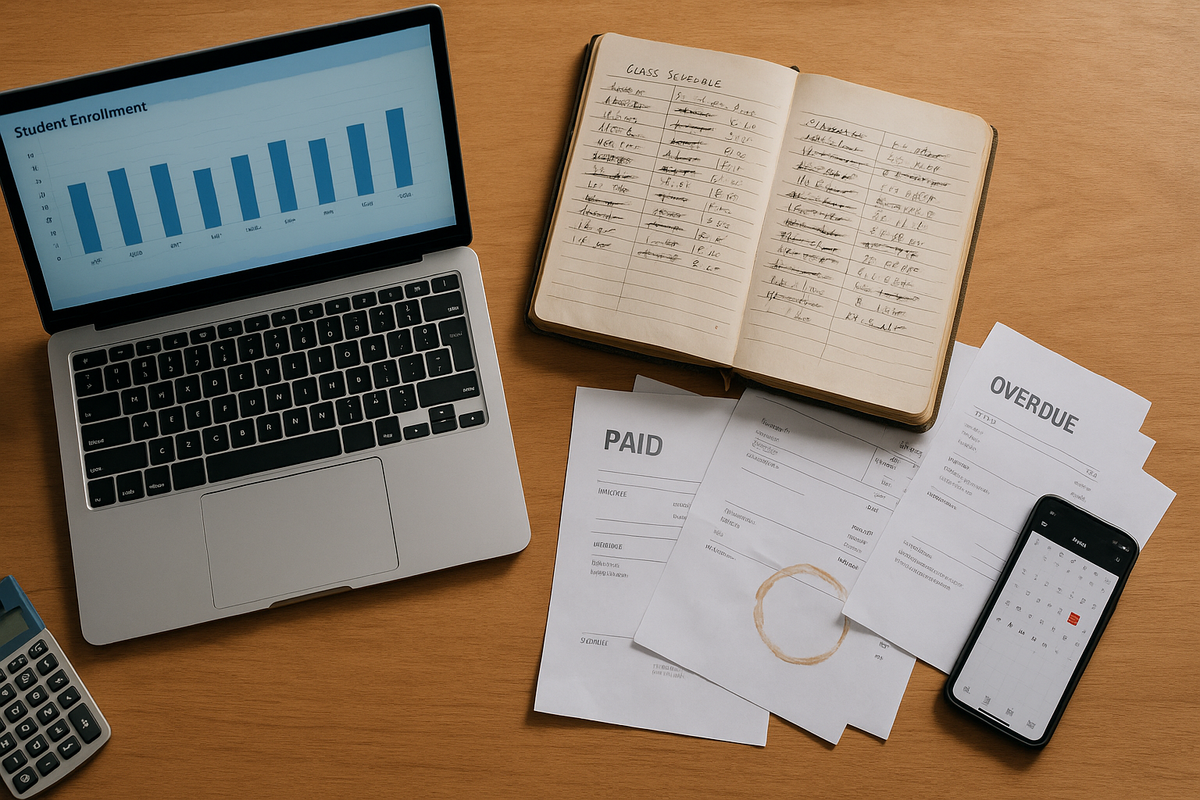
When billing tasks consume 5 hours weekly, the opportunity cost at $50/hour equals $1,000 monthly, before accounting for payment leakage from skipped late fees, missed autopayments, or families who simply forget to pay without automated reminders. Free software becomes expensive when "free" means moving identical information among Google Forms, Excel spreadsheets, Outlook calendars, Gmail, and Venmo every week.
Software not purpose-built for dance studios lacks industry-specific functionality around recital management, costume ordering, competition team billing, or family account structures where one parent pays for three siblings across five different class types. Generic booking tools designed for hair salons or personal trainers require significant manual workarounds to handle these scenarios. As one studio owner noted in cross-industry research on administrative automation, studios using management software see 30% higher retention partly because families experience fewer billing surprises and communication gaps.
Many owners discover that total cost of ownership includes migration expenses when free software inevitably fails at scale. Moving 200 family accounts with payment histories, waitlists, and custom pricing agreements from spreadsheets into integrated software costs $500-$3,000 in data cleanup and staff retraining, whether done internally or through vendor migration services.
What Paid Platforms Actually Cost in 2026
Paid dance studio software pricing varies dramatically based on student count, feature tier, and whether the platform bundles payment processing or charges separately.
Studio Pro pricing starts at $40/month for unlimited students, positioning itself as one of the only dance platforms offering flat-rate pricing regardless of enrollment. Jackrabbit Dance plans start at $49 monthly for basic features, scaling to $245+ for enterprise tier with advanced reporting and multi-location management. Mindbody's Starter plan is listed at $99/month with no current free trial, requiring immediate commitment.
Core subscription fees represent only part of total costs. Payment processing adds 2-3% of transaction volume, whether handled by the platform or through separate processors like Stripe or Square. Optional modules for payroll integration, advanced marketing automation, or custom mobile apps add 15-30% to base pricing. One-time costs include implementation, data migration from existing systems, and staff training.
Per-student pricing models create unpredictable scaling costs. A platform charging $1 per active student monthly costs $75 at 75 students but $250 at 250 students, potentially exceeding flat-rate competitors as the studio grows. Studios must model pricing at current enrollment plus 50% growth to avoid budget surprises when operations outgrow current software capacity.
When Studios Switch From Free to Paid
The decision to migrate from free or low-cost software to paid platforms follows predictable trigger points related to enrollment thresholds and operational complexity.
Automated software reduces administrative overhead from 10 hours weekly to under 3 hours, creating a clear ROI threshold. At 5 hours saved weekly and $50/hour opportunity cost, paid software justifies $1,000 monthly in subscription fees before breaking even. Most studios hit this threshold between 75-100 active students, when manual processes for billing, attendance tracking, and family communication become unsustainable.
Studio owners report specific pain points that trigger software searches. When registration opens for a new season and 40 families email questions about class times instead of checking a parent portal, that's a sign current tools fail at self-service. When costume orders for the spring recital require three separate spreadsheets and parents still receive incorrect sizing information, integration gaps cost more than software subscriptions. When a family disputes a late fee because they never received an overdue notice that was manually sent to an outdated email address, the risk of relationship damage exceeds technology costs.
However, choosing based on features alone creates different problems. Many owners fall into the trap of buying systems with a thousand buttons but using only ten. Feature bloat carries hidden costs in training time, interface complexity, and monthly fees for capabilities the studio never actually needs. A 50-student studio teaching recreational classes does not require competition team travel management, merchandise inventory systems, or franchisee reporting that enterprise platforms include.
Avoiding Common Pricing Traps
Software purchasing decisions made during the chaos of registration week or recital planning often overlook contract terms that create long-term costs.
Watch for per-student pricing that scales unpredictably as enrollment grows, particularly platforms that count inactive students or charge for family members individually rather than per family unit. Hidden fees for SMS messaging, email volume above monthly caps, or payment processing through required vendor partnerships add costs that don't appear on pricing comparison charts.
Long-term contracts with early termination penalties lock studios into platforms even after discovering critical missing features or poor customer support. Annual prepayment discounts create sunk costs that discourage switching when better options emerge. Features locked behind higher-tier plans that you need from day one, like family account structures or waitlist management, force immediate upgrades that negate entry-level pricing advantages.
Switching costs compound when platforms bundle website hosting, payment processing, and marketing tools that work only within their ecosystem. If you already have a website, a payment processor relationship, and established workflows, a platform requiring its own payment processing with extra marketing tool costs and no phone support creates real switching friction even if monthly fees appear competitive.
What This Means for Studio Operators
Editorial analysis, not reported fact:
Free dance studio software serves legitimate use cases for instructors teaching 1-3 weekly classes, new studios in their first season, or specialized programs like competition teams that need scheduling tools but handle billing separately. The mistake is staying on free tools after crossing operational thresholds where manual processes cost more than automation.
Calculate your true hourly cost for administrative tasks, including not just owner time but also front desk staff, payment reconciliation, late payment follow-up, and error correction from disconnected systems. If that total exceeds $200 weekly, paid software with proper integration pays for itself even at entry-level pricing. The analysis changes when affordable studio management software provides capabilities that previously required corporate infrastructure.
Studios considering software changes should test platforms during low-stress periods, not during registration weeks when learning curves disrupt operations. Request data migration estimates in writing, confirm whether payment processor relationships transfer or require new merchant accounts, and verify that customer support includes phone access during your business hours, not just email ticketing systems with 48-hour response times.
The "best" studio software is the one that solves your actual operational problems at a price point where saved time and reduced errors justify the cost. For a 40-student studio where the owner teaches every class and handles billing in 2 hours weekly, free tools with manual workarounds may remain optimal. For a 200-student program with front desk staff, multiple instructors, and complex family billing scenarios, continuing with outgrown management software costs far more than monthly subscription fees, even at premium pricing tiers.
Sources & Further Reading
- Capterra's free dance studio software options and buyer priorities, 2026 market research on critical features
- Dance Studio Manager comparison of free versus paid platforms, August 2026 analysis
- Swyvel's free versus paid software analysis, examining hidden costs and switching friction
- Jackrabbit Dance perspective on free software, including pricing tiers and common migration triggers
- Mindbody's 2026 platform comparison, April 2026 feature and pricing analysis
- Alpha Software pricing and feature comparison, detailed cost breakdown for leading platforms
- Koalendar review of dance studio software options, July 2026 evaluation
- Presently's honest comparison of studio platforms, focusing on automation ROI
Editorial coverage of publicly reported industry developments. Dance Studio Journal has no commercial relationship with any companies named.