Recital Insurance: What's Covered and What's Not
Athletic participant exclusions, venue liability splits, and certificate requirements expose studios during recital season. Here's what your policy actually covers off-site.
Key Takeaways
- Athletic participant exclusions in general liability policies often exclude injuries to performers during recitals and competitions, leaving studios exposed unless they purchase separate event coverage starting around $175 to $185 per day.
- Venue certificate requirements typically demand $1 million to $2 million coverage naming the theater or auditorium as additional insured, and indemnification clauses in rental contracts shift liability for studio negligence back to you, not the venue's insurer.
- Backstage supervision gaps create the highest recital-day risk: costume changes, dim lighting, and tight schedules fall under studio responsibility, not venue premises liability, and are only covered if your policy includes off-site locations.
- Standard property damage liability protects third-party claims but does not cover accidental damage to rented premises such as scuffed theater floors or broken equipment unless you add Damage to Rented Premises or Inland Marine coverage.
- Business interruption insurance is critical for recital season, when studios earn 25 to 40 percent of annual revenue in a compressed May-to-July window; policies typically require 48 to 72 hours of forced closure before benefits begin.
What Your General Liability Policy Does and Does Not Cover Off-Site
General liability insurance for dance studios costs an average of $55 per month or $654 annually and covers bodily injury and property damage claims. If a parent slips in the lobby during a recital, this policy helps pay medical bills and legal defense costs. But recitals introduce a critical gap: the athletic participant exclusion.
Most general liability policies exclude injuries to participants during athletic or performance activities. If you hold dance competitions or public recitals, your base policy likely excludes liability claims related to injuries during the event itself, such as a dancer landing wrong during a performance or getting hurt backstage. This exclusion catches many studio owners off guard because they assume their year-round coverage extends automatically to recital day.
Recital insurance coverage fills this gap. Specialized carriers now offer event policies that explicitly include rehearsals, performances, and competitions. Without this add-on, a torn ACL during a grand jeté onstage or a broken wrist in the wings may fall outside your protection.
The Venue Liability Split: Who Covers What
When you rent a theater, performing arts center, or school auditorium, responsibility splits between building safety and activity supervision. The venue's insurance handles structural hazards like faulty lighting rigs or unsafe seating. Your studio remains responsible for supervising dancers and managing backstage areas.
This distinction matters because venue indemnification clauses shift liability back to you. Standard rental agreements state that the lessee must indemnify, defend, and save harmless the venue from claims arising out of any act or neglect by the lessee, its agents, employees, or contractors. Translation: if your choreographer leaves a costume rack blocking an exit and someone trips, the venue's insurer will not cover you. The venue's insurance only provides coverage for the venue's own actions, not yours.
Certificate of Insurance and Additional Insured Requirements
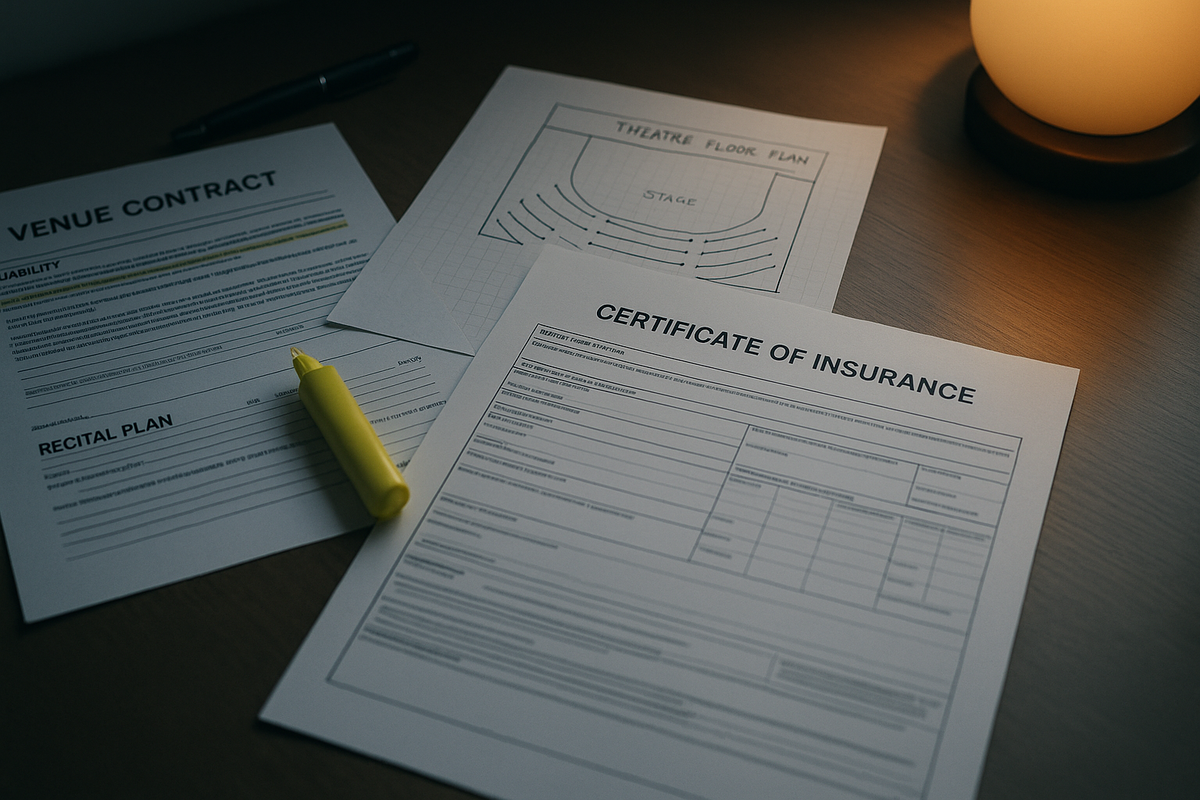
Most landlords and performance venues require proof of insurance before you can host a recital. Certificates of insurance typically specify $1 million to $2 million in coverage and name the venue as an additional insured. An additional insured enjoys the benefits of being insured under your policy, so the venue is protected from new risks that arise from your studio's activities.
If your policy does not include off-site locations or does not allow additional insured endorsements, you will need to purchase short-term event coverage. Companies like Thimble and CPH offer dance show event insurance starting at $175 to $185 per day, covering setup, performance, and breakdown at the $1 million per occurrence limit most venues require.
Backstage Risk and What Actually Causes Claims
Recital day concentrates hazards. Quick costume changes, dim lighting, and tight schedules raise the risk of trips and falls. Backstage areas need clear walking paths and intensive adult supervision. From costume racks falling to spills near makeup stations, these are studio operational risks, not venue structural risks.
Your general liability policy covers these incidents only if it explicitly includes off-site locations and does not exclude performance-related claims. Many base policies assume operations occur within your leased studio space. If your certificate of insurance does not list theaters, hotels, or convention centers as covered locations, you are exposed.
Coverage Gaps Studio Owners Miss
Three gaps emerge repeatedly when studios file recital-related claims. First, base property damage liability only protects against third-party property damage, such as a neighboring tenant's equipment. It does not cover accidental damage you cause to the venue itself. Scuffs left on a theater's Marley floor or broken lighting equipment require Damage to Rented Premises coverage, which must be added separately.
Second, equipment and property inside your rented space require Inland Marine coverage. This protects your own mirrors, barres, sound systems, and costumes during transport and setup. Standard policies exclude coverage for your property once it leaves your studio.
Third, instructors who have added new activities since their last policy check are most likely to find gaps. By adding outside performances, workshops, or competitions to a lineup of recreational classes, a studio alters its risk profile. Policies must be updated to reflect these changes, or the carrier may deny a claim citing undisclosed activities.
Waivers Are Not Enough
Waivers are useful, but they are not a complete risk management solution for a dance school. Parents or adult students can still file a claim or lawsuit even if they signed a release. Legal responsibility depends on how the injury happened and whether the studio acted with reasonable care.
Courts often find waivers unenforceable if the studio was grossly negligent or if the injured party is a minor. In many states, parents cannot waive a child's right to sue. Waivers help demonstrate that participants understood the risks, but they do not replace insurance. Waivers reduce but don't eliminate risk, and studios must pair them with adequate liability coverage.
Accident Insurance vs. Liability Insurance
Accident insurance helps pay for medical bills of an injured participant. If a dancer gets hurt during a recital and has to go to the doctor, an accident policy can help pay for medical bills up to the policy's limits. This is separate from liability insurance and is optional in most base policies.
Liability insurance responds when the studio is found legally responsible for an injury. Accident insurance pays regardless of fault, covering emergency room visits, X-rays, and follow-up care. For studios hosting large recitals with 100-plus participants, accident insurance reduces the likelihood that a minor injury escalates into a lawsuit because families can file a claim without proving negligence.
Business Interruption and Recital Season Concentration
Business interruption insurance covers lost income during forced closure. For dance studios, this coverage is uniquely relevant because many studios earn 25 to 40 percent of annual revenue in the May-to-July recital and competition window. A closure during that period erases a disproportionate share of yearly income.
The typical waiting period is 48 to 72 hours before benefits begin. If a recital venue floods the day before your show and you lose ticket sales, costume fees, and DVD orders, business interruption coverage reimburses lost revenue. Without it, a single venue emergency can sink a studio's cash flow for the rest of the year.
Travel, Competitions, and Extended Liability
For competitive dance studios traveling to regional and national events, the standard general liability policy does not cover student injuries during travel itself, such as hotel falls, transportation accidents, or off-site recreational activities. Travel-specific endorsements and performer accident coverage pay medical bills at competition venues and during associated travel.
Studios must confirm that their policy covers sanctioned travel events and that competition organizers' certificate of insurance requirements are met. Many national competitions require proof of $2 million aggregate coverage and will not allow teams to compete without it.
Checklist: Reviewing Your Policy Before Recital Season
Before signing a venue contract or printing tickets, studio operators should confirm the following with their insurance carrier:
- Does my general liability policy cover off-site locations, including theaters, hotels, and convention centers?
- Does my policy exclude athletic participant injuries during performances and competitions?
- Can I add the venue as an additional insured, and is there a fee per certificate?
- Do I have Damage to Rented Premises coverage, and what is the sublimit?
- Does my policy include Inland Marine coverage for transported equipment and costumes?
- Is accident insurance included, or do I need to purchase it separately?
- Does business interruption coverage apply to recital-specific revenue loss, and what is the waiting period?
- Are high-risk activities such as aerials, partner lifts, or tumbling explicitly covered?
Limits typically range from $500,000 to $2 million per occurrence and up to $5 million aggregate. Most studios carry either $1 million, $2 million, or $3 million in coverage depending on recital size and venue requirements.
What This Means for Studio Operators
Editorial analysis, not reported fact:
Recital season is when revenue concentrates and risk multiplies. Studios that treat recitals as an extension of regular operations without updating insurance policies expose themselves to catastrophic financial loss. A single claim for a backstage fall, a denied certificate of insurance, or an indemnification demand from a venue can cost tens of thousands of dollars and delay or cancel a show that represents months of planning and a quarter of annual revenue.
The most dangerous assumption is that general liability coverage bought for in-studio classes automatically extends to off-site performances. It does not. Athletic participant exclusions, venue indemnification clauses, and travel gaps require deliberate policy updates and often separate event coverage. Studios should review policies annually in January or February, well before recital contracts are signed, and budget $175 to $500 for single-event coverage if base policies exclude performances.
Investing in structured conditioning programming and injury-prevention training also reduces claims frequency, which can lower premiums over time. Pairing comprehensive recital insurance coverage with preventive measures and clear communication with venues creates a defensible, sustainable approach to operational risk management.
Sources & Further Reading
- Insurance Canopy: Dance Studio Insurance, average costs and general liability coverage basics
- Vibe Fam: Dance Studio Insurance in 2026, recital and off-site liability, venue requirements, certificates of insurance
- Jackrabbit Dance: Dance Studio Insurance Basics, athletic participant exclusions and event coverage
- Nexo Fit: Liability During Rehearsals or Recitals, venue vs. studio responsibility splits
- Dance Studio Insurance: Off-Site Sessions Coverage, travel and competition liability endorsements
- XINSURANCE: Dance Studio Insurance, property damage liability and coverage limits
- Formfy: Dance Studio Liability Waivers, legal enforceability and limitations
- The Event Helper, short-term event insurance pricing and TULIP policies
Editorial coverage of publicly reported industry developments. Dance Studio Journal has no commercial relationship with any companies named.