What Certifications to Require When Hiring Dance Teachers
Dance studios face no legal certification mandate, but smart hiring blends safety screening, technical skill verification, and strategic credentials.
Key Takeaways
- Certification requirements vary widely: Dance studios face no universal legal mandate for instructor certification, but programs range from $400 to $6,200 depending on organization and specialty.
- Background checks and safety screening are the true baseline: States like California require background checks for staff with unsupervised minor access, and child protection training is becoming a standard expectation across the industry.
- CPR and First Aid certification matters for liability: Many insurers and educational partners require on-site staff to hold current CPR and First Aid credentials, with some studios subsidizing these costs.
- Experience can substitute for formal credentials: High-volume chains like Fred Astaire Dance Studios hire inexperienced teachers and provide in-house training, prioritizing demonstrated technique over formal certification.
- Certifications enhance competitive positioning: Hiring credentialed instructors improves studio reputation and differentiates your business, especially when parents research teacher qualifications before enrollment.
Understanding the Fragmented Dance Certification Landscape
Dance studio owners operate in a regulatory gray zone. Unlike K-12 settings where teachers need bachelor's degrees and state teaching licenses, private studios face no formal legal requirement to hire certified instructors. However, certifications significantly increase hiring prospects, creating a competitive expectation even without legal mandate.
Major certification bodies include the National Dance Education Organization (NDEO), Dance Educators of America (DEA), Royal Academy of Dance (RAD), and Dance Masters of America (DMA). Costs span a wide range: programs range from $400 to $6,200, with NDEO's Certificate in Dance Instruction requiring approximately $5,500 to $6,200 over three to five years for 33 units. These investment levels mirror trends in adjacent studio industries, where certification costs and hiring standards create similar financial barriers for entry-level instructors.
The Non-Negotiables: Background Checks and Safety Training
Editorial analysis, not reported fact: While dance certifications remain optional in most markets, background screening has shifted from nice-to-have to essential liability protection. California requires background checks for employees with unsupervised minor access, and nonprofit partners, school boards, and educational institutions mandate criminal record checks for both instructors and volunteers at student performances.
Smart studios implement comprehensive screening protocols regardless of local mandates. Industry best practices recommend requiring references from other studios or schools, conducting criminal background checks for all staff including guest artists and last-minute substitutes, and training employees on child protection policies, abuse recognition, and reporting procedures. Youth Protection Advocates in Dance (YPAD) provides certification and resources developed by subject matter experts specifically for implementing these standards across dance education settings.
CPR, First Aid, and Insurance Requirements
Dance instructors should hold valid CPR and first aid certifications, a requirement enforced by nonprofit partners and school boards. Some private studio owners cover or subsidize these training costs to maintain compliance. Additionally, many studios require teachers to carry liability insurance, while fitness centers hiring dance instructors typically mandate group fitness or specialized certifications like Zumba.
These requirements reflect broader liability trends. Similar to how liability insurance requirements became standard after injury claims averaged $25,000 in adjacent movement disciplines, dance studios increasingly view safety certifications as risk mitigation rather than optional credentials.
Balancing Certification Against Experience and Training Capacity
The certification-versus-experience trade-off varies by studio business model. Some studios hire teachers with no formal credentials annually, prioritizing demonstrated technique, performance experience, and willingness to participate in in-house training. Organizations like Fred Astaire Dance Studios do not require prior experience and provide training programs or boot camps for new hires.
For studios choosing this path, dance instructors need extensive performance experience and ideally at least one year as an assistant teacher. This model trades upfront credential verification for investment in structured onboarding and mentorship. Studios pursuing this approach should recognize the hidden costs: instructor retention costs range from 50 to 200 percent of annual salary when turnover occurs, making robust training programs a strategic commitment rather than a hiring shortcut.
When Certification Becomes Your Competitive Advantage
Hiring qualified instructors enhances studio reputation, particularly when parents research teacher backgrounds before enrollment. Studios focused on classical ballet benefit from requiring RAD or Cecchetti certification, while education-focused or contemporary programs gain credibility through NDEO or DEA credentials. Employing teachers with recognized qualifications improves overall standing and differentiation against competitors.
This positioning strategy parallels developments in specialized movement instruction, where specialized certification needs extend beyond standard credentials to address specific populations. Studios targeting competitive teams, therapeutic populations, or partnership contracts with schools should prioritize certifications aligned with those specialized contexts.
Building Your Hiring Standards Framework
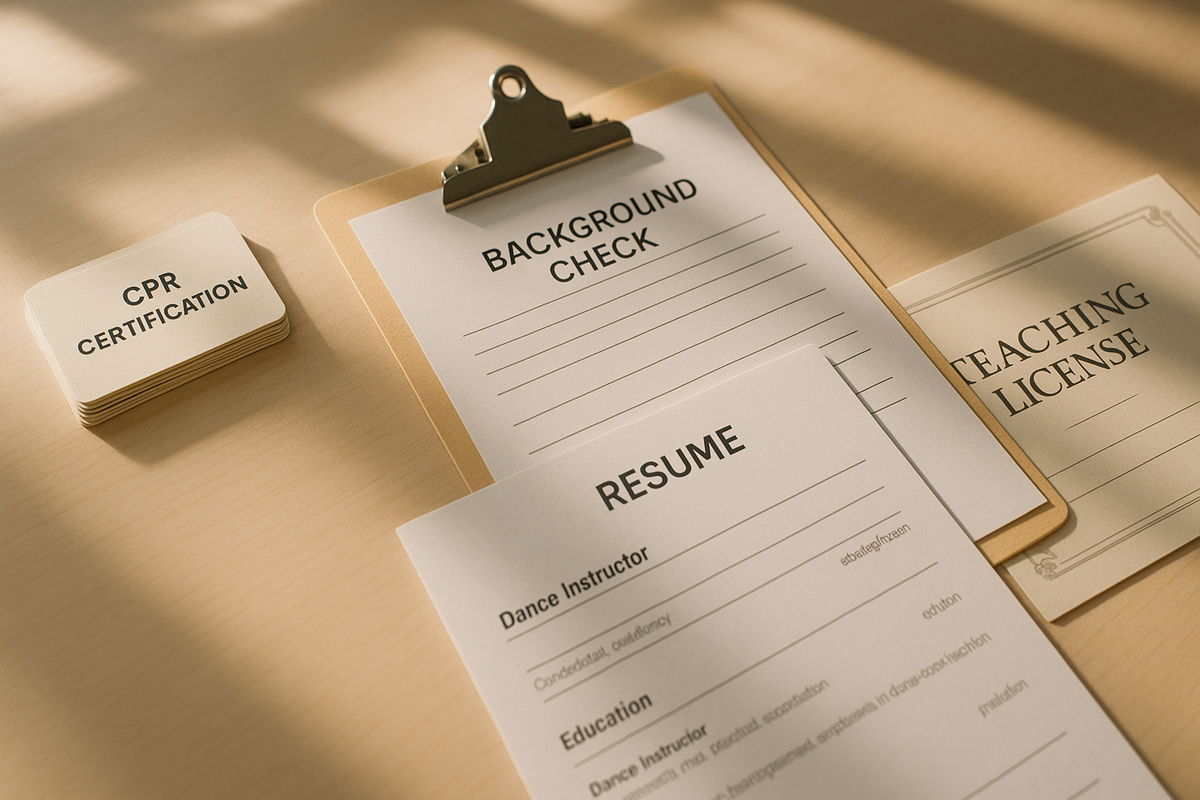
Effective studio hiring policies layer three distinct requirement tiers. The foundation consists of non-negotiable safety and legal compliance: background checks, child protection training, CPR, and First Aid certification. The second tier addresses technical competence through demonstrated dance experience, performance background, and teaching ability verified through auditions or trial classes. The third tier incorporates formal certifications that align with studio positioning, whether discipline-specific credentials like RAD for ballet programs or broad teaching certifications like NDEO for community-focused studios.
Studios should document these standards in writing and apply them consistently. Credential verification strategies should include publishing instructor lineage with verifiable links to certifying organizations, particularly as parents increasingly research staff qualifications online. For ongoing professional development, consider how staff training requirements include emergency response procedures alongside continuing education through workshops or recertification courses.
What This Means for Studio Operators
Editorial analysis, not reported fact: The smartest approach for 2026 recognizes that certification questions have no universal answer. Studios serving recreational students in unregulated markets can prioritize experience and in-house training while maintaining rigorous safety screening. Studios positioning as premium educational institutions or pursuing school partnerships need formal credentials that signal professionalism to institutional buyers and educated parents.
The liability landscape, however, is converging toward uniform baselines. Background checks, child safety training, and CPR certification are becoming expected standards regardless of market positioning. Studios that treat these as optional expose themselves to preventable legal risk and reputational damage. Build your hiring framework by making safety compliance mandatory, technical competence verifiable through demonstrated skill, and formal certification strategic based on your competitive positioning and target market expectations.
Sources & Further Reading
- Insurance Canopy: How to Become a Dance Teacher, covering certification costs and hiring expectations across studio types
- National Dance Education Organization Certificate in Dance Instruction, detailing NDEO's 33-unit certification program structure
- Faster Capital: Dance Studio Compliance Guide, addressing background check requirements and child protection statutes
- Youth Protection Advocates in Dance, providing certification and resources for child safety implementation in dance education
- Dance Data Project: Safety and Best Practices Guidelines, outlining industry standards for background checks and safety training
- Class Manager: Keeping Staff Certifications Current, offering compliance checklists for CPR, First Aid, and ongoing certification tracking
Editorial coverage of publicly reported industry developments. Dance Studio Journal has no commercial relationship with any companies named.