Smart Equipment Investments for Dance Studios in 2026
Sprung flooring, mirrors, barres, and sound systems anchor the $49,000–$94,000 equipment budget. Where to invest first and what to delay until cash flow stabilizes.
Key Takeaways
- Sprung or floating flooring ($5,000–$15,000) remains the single most critical safety investment for dance studios in 2026, protecting dancers from injury and establishing professional credibility, while AI-driven smart floors capture only 20% of the market as a premium option.
- Initial studio capital expenditure totals $49,000–$94,000 for essential equipment including specialized flooring ($15,000), mirrors and barres ($12,000), sound systems ($1,000–$8,000), and technology infrastructure ($11,500), with renovation costs adding $10,000–$25,000 depending on space size.
- Purpose-built sound systems (150-watt powered speaker pairs, $1,000–$3,000) now outperform Bluetooth speakers for consistent clarity across barre work and choreography, with acoustic panel mitigation essential in high-ceiling spaces to control echo.
- Mirrors ($2,000–$5,000) and barres ($500–$2,000) anchor instructional quality, with shatterproof or glassless mirror technology and portable wheeled designs offering safety and flexibility for multi-use studio spaces.
- Costume and prop vendors offer bulk discounts up to 80% off through specialty suppliers like Weissman, Images Dance Costumes, and Dino Rentos Studios, making commercial buying a key budget lever for recital and performance seasons.
- Working capital requirements ($906,000 in Month 1 per industry planning models) dwarf equipment costs, underscoring that flooring and mirrors are just one piece of a comprehensive cash-flow strategy for new studio launches.
Why Flooring Remains the Foundation of Every Dance Studio Investment
Sprung or floating floors represent the single non-negotiable equipment investment for dance studio owners in 2026. According to industry flooring guidance, these systems typically cost between $5,000 and $15,000 depending on space size, yet they protect both dancer safety and studio reputation by reducing injury risk during advanced technique work.
Marley-style vinyl surfaces layered over sprung subfloors remain the industry standard, offering excellent grip and joint protection across ballet, jazz, and contemporary genres. Market research published in 2026 indicates that while AI-driven dancefloors with motion-sensing and adaptive lighting could capture 20% of the commercial market by year-end, traditional sprung and semi-sprung systems continue to dominate performance-focused studios. Smart flooring interfaces with virtual reality and smart mirrors, but remains a premium add-on rather than a foundational requirement for most US studios operating on realistic budgets.
Experts note that sprung systems allow dancers to train harder and longer with confidence, making the $15,000 investment a cornerstone of professional infrastructure rather than an optional upgrade.
Mirrors, Barres, and the $12,000 Core Instruction Budget
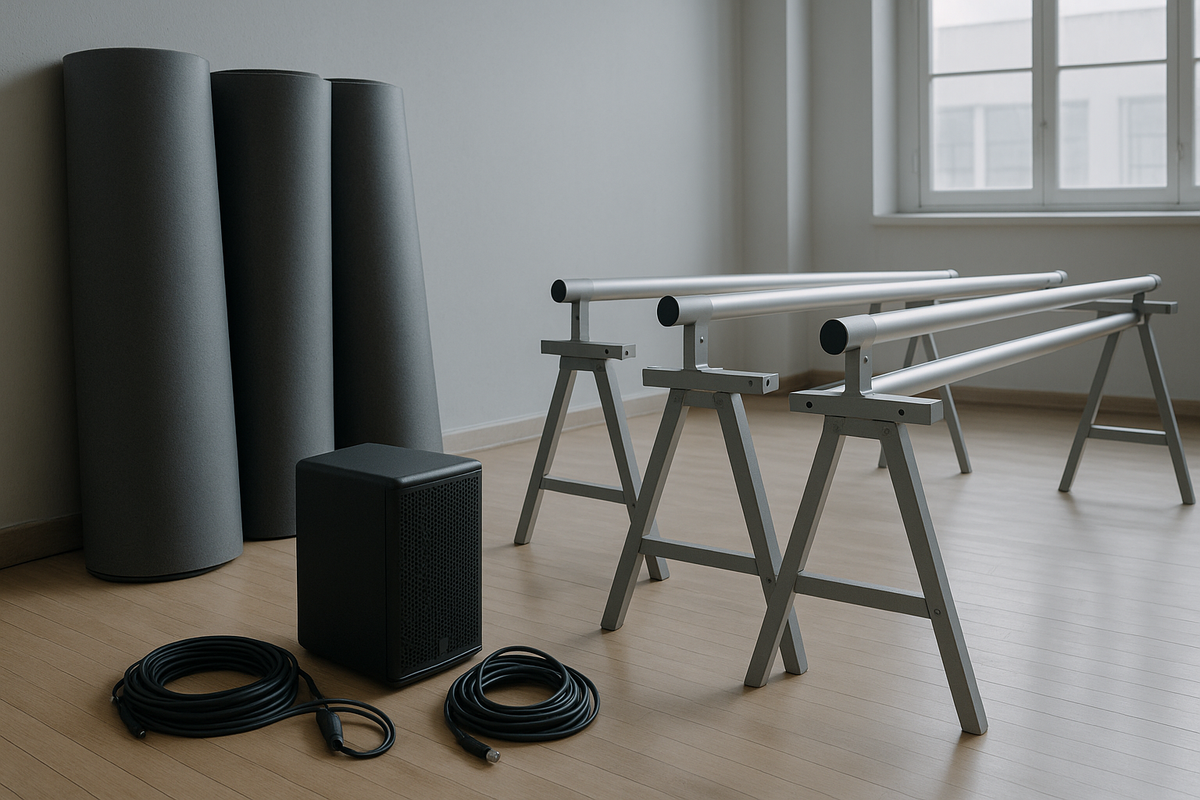
Full-length mirrors and sturdy barres form the visible backbone of dance instruction, requiring approximately $12,000 in combined capital expenditure for wall-to-wall installation. Industry suppliers report that full-length mirrors run $2,000–$5,000, while barres cost $500–$2,000 depending on wall-mounted versus portable wheeled configurations.
Shatterproof or glassless mirror technology has become a key safety differentiator in 2026, particularly for studios serving younger students or offering high-energy combo classes. According to dance school equipment consultants, barres are absolutely crucial for improving balance and flexibility, especially for beginners and young dancers still developing core strength and turnout.
Portable wheeled mirror and barre systems offer flexibility for studios that host multiple disciplines or rent space for non-dance activities, allowing rapid reconfiguration between ballet, hip-hop, and fitness programming without permanent installation constraints.
Sound Systems Built for Clarity, Not Volume: The $1,000–$8,000 Spectrum
Over the past year, independent studios have shifted from consumer-grade Bluetooth speakers to purpose-built audio systems, prioritizing consistent clarity across floorwork, barre exercises, and choreography drills over sheer volume. Audio consultants recommend that 80 to 200 watts provides sufficient power for most teaching environments, with 150-watt powered speaker pairs and Bluetooth plus auxiliary input covering 90% of daily needs for studios under 1,200 square feet.
Budget allocation ranges from $1,000–$3,000 for a solid prosumer setup to $8,000 for professionally installed multi-room systems with wireless microphone integration. A 2025 installation case study describes a split-design system connecting loudspeakers to both in-studio instruction and virtual learning platforms, with headset wireless microphones ensuring instructors are heard clearly in hybrid class formats.
Acoustic treatment has emerged as an essential companion investment. High-ceiling spaces with exposed rafters and concrete create significant echo problems; installers report that adding acoustic panels to walls absorbs echo to a workable extent, improving both in-person and recorded audio quality without requiring ceiling reconstruction.
Costumes, Props, and the Commercial Buying Advantage
Costume acquisition for recital and performance seasons operates through specialty vendors offering bulk discounts up to 80% off retail pricing. Major US suppliers include Weissman, Images Dance Costumes, and Dino Rentos Studios, the latter specializing in custom props ranging from Cleopatra carry seats to oversized seashells for mermaid-themed routines.
Handheld props such as umbrellas, canes, suspenders, and costume wings remain popular for musical theater and character work, with vendors stocking fairy wings, pixie accessories, and witch-themed pieces for seasonal showcases. Commercial buying relationships allow studio owners to negotiate volume pricing and secure consistent inventory for multi-class recital lineups, turning costume procurement into a manageable line item rather than a per-family negotiation.
The Real Capital Requirements: $49,000 in Equipment, $906,000 in Working Capital
Financial planning models published in 2026 show that initial capital expenditure for specialized equipment totals approximately $49,000, breaking down to $15,000 for specialized dance flooring, $12,000 for mirrors and barres installation, and $11,500 for core technology infrastructure including sound systems and point-of-sale hardware for member management.
Studio setup costs range from $35,000 to $80,000 when including lease deposits and initial furnishings, with renovation expenditures adding $10,000–$25,000 based on space size and design improvements needed to meet professional standards. However, the same planning models emphasize that working capital requirements dwarf equipment investment, with $906,000 needed in Month 1 to cover fixed costs and operating expenses before cash flow stabilizes.
This underscores a critical reality for new studio owners: flooring, mirrors, and sound systems represent essential but relatively modest pieces of a much larger financial puzzle that includes instructor payroll, rent, insurance, marketing, and multi-month runway before breakeven.
Choosing Vendors: Established Suppliers and Cost-Benefit Discipline
Major US dance equipment suppliers include Alvas (ballet barres, glassless mirrors since 1952), Dance Equipment International, Stagestep, Harlequin Floors, and STM Studio Supplies. Alvas has been providing high-quality ballet barres, dance floors, and glassless mirrors to ballet studios worldwide for over seven decades, establishing a reputation for durability and safety compliance.
Vendor selection in 2026 hinges on three factors: product warranties (especially for flooring systems expected to last 10-15 years), installation support (particularly for sound and mirror mounting in non-standard spaces), and compatibility with existing infrastructure (ensuring new barres fit wall studs and sound systems integrate with streaming platforms). Cost-benefit discipline means resisting premature investment in smart mirrors or interactive LED floors until core instructional equipment, liability insurance, and three months of operating reserves are secured.
What This Means for Dance Studio Owners
Editorial analysis — not reported fact:
Studio owners launching or renovating in 2026 face a clear hierarchy of investment priorities. Sprung flooring and acoustic-quality sound systems are safety and instructional non-negotiables that directly affect retention, injury rates, and word-of-mouth reputation. Mirrors and barres come next, forming the visible scaffolding of professional technique training. Everything else, including smart floors, AI-driven mirrors, and premium prop inventories, belongs in a Phase 2 capital plan after the studio demonstrates six months of positive cash flow.
For owners tempted by technology vendors promising competitive differentiation, the data suggests a sobering reality: traditional equipment still defines the student and parent experience, and no amount of LED floor effects compensates for poor shock absorption or muddy audio during across-the-floor combinations. Allocate the $49,000–$94,000 equipment budget to fundamentals first, then revisit smart upgrades when enrollment justifies the marginal return.
Commercial buying relationships for costumes and props offer a quiet but meaningful budget lever. Locking in 80% discounts through established vendors like Weissman or Dino Rentos Studios reduces per-dancer costume fees, easing a common parent friction point during recital season and improving net margins without raising tuition. For multi-location or franchise operators, centralized bulk purchasing creates economies of scale that single-studio owners can approximate through vendor partnerships and annual order consolidation.
Sources & Further Reading
- Dance Advantage: Dance Studio Flooring Guide — Overview of sprung, floating, and marley flooring systems with cost ranges and safety considerations.
- LinkedIn: Dance Studio Flooring Market Trends & Growth Forecast Report (2026) — Market analysis on AI-driven flooring, sustainability certifications, and technology adoption rates.
- Dance Advantage: Ballet Barres Buying Guide — Wall-mounted versus portable barre options, installation tips, and safety features.
- Dance Advantage: Best Speakers for Dance Teachers — Wattage recommendations, Bluetooth versus wired systems, and acoustic treatment strategies.
- LinkedIn: Dance Studio Sound System Installation Case Study — Real-world example of wireless microphone integration, acoustic panel mitigation, and hybrid class audio.
- Weissman Dance Costumes — Major US costume vendor offering bulk purchasing and seasonal collections.
- Dino Rentos Studios — Custom prop fabrication for pageants, recitals, and musical theater productions.
- LinkedIn: Dance Studio Business Plan Example & Profitability Analysis (2026) — Financial model detailing $49,000 equipment CAPEX, $906,000 working capital requirements, and renovation cost ranges.
- Alvas Ballet Barres & Dance Mirrors — Established US supplier of barres, glassless mirrors, and flooring since 1952.
Editorial coverage of publicly reported industry developments. Dance Studio Journal has no commercial relationship with any companies, studios, competitions, conventions, or organizations named.