Recital Program Books as a Sponsorship Revenue Stream
How dance studios turn recital programs into a dual-revenue profit center, with real pricing, sales strategies, and case studies netting up to $25,000 annually.
Key Takeaways
- Dual-revenue model: Recital program books generate income from both business sponsorships and family dedication pages, with many studios earning more from dedications after the first year due to higher margins and easier conversion.
- Profit potential: A small studio can net $1,300 on a $700 print run with $2,000 in ad revenue, while sophisticated operators report upward of $25,000 in program profit, enough to cover entire summer studio expenses.
- Sales strategy: Start with last year's sponsors (renewals close 3-4 times faster than cold outreach), create a one-page sell sheet with audience demographics and pricing tiers, and set deadlines 4-6 weeks before printing.
- Print versus digital tension: Digital programs reduce costs and environmental impact but may lower sponsor appeal because coupons require downloading or printing, reducing effectiveness and revenue potential.
- Margin context: With dance studio profit margins at only 10-30%, auxiliary revenue streams like recital programs matter for operating viability and seasonal cash flow.
Why Recital Programs Are a Revenue Priority in 2026
Recital program books have evolved from informational handouts into a measurable profit center for U.S. dance studios. With dance studio profit margins typically between 10% and 30%, every auxiliary revenue stream counts. A small studio netting $2,000 in ad revenue on a $700 print run walks away with $1,300 in profit on the program alone, before considering branding and enrollment impact.
At the high end, one Cape Coral, Florida studio owner has consistently reported upward of $25,000 in recital book profit, which can pay for entire summer studio expenses. These programs serve dual purposes: they offset recital costs while building brand loyalty through keepsakes that end up on refrigerators and in memory boxes across hundreds of households.
The Dual-Revenue Model: Business Sponsors Plus Family Dedications
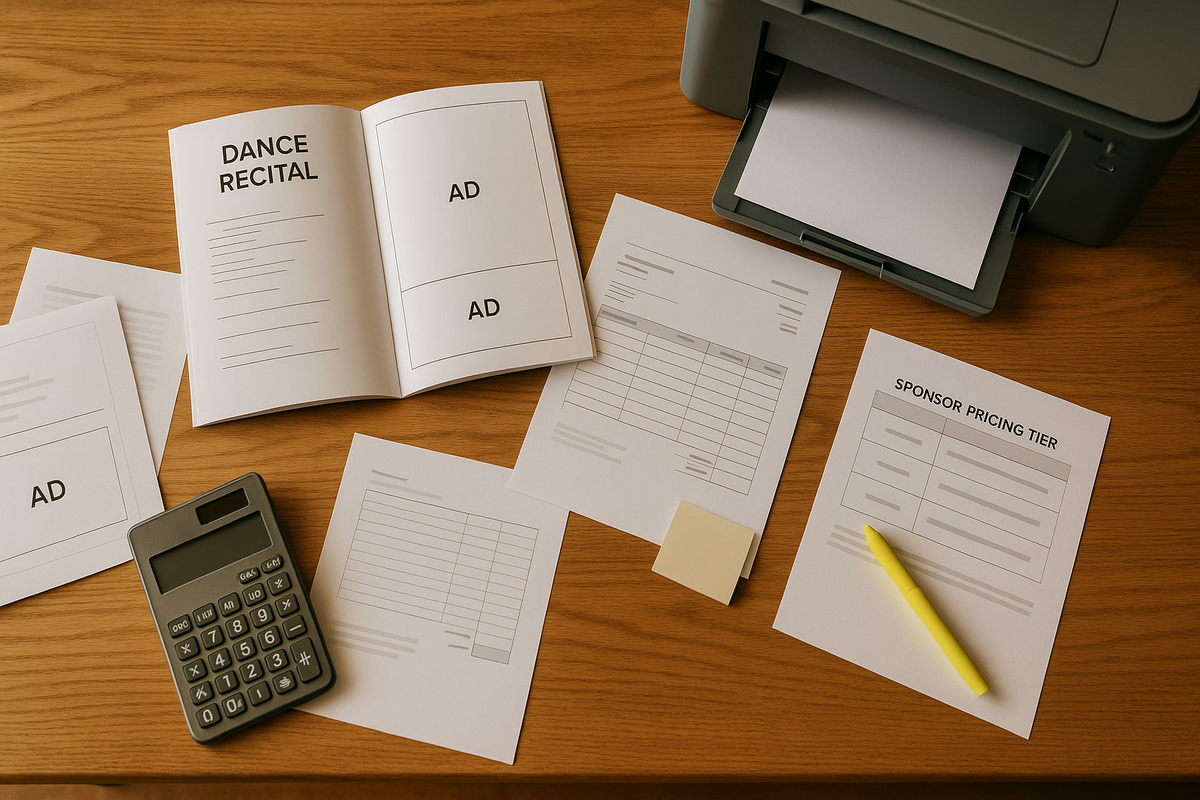
Studios raise funds by selling advertising space to local businesses, identifying potential sponsors and reaching out with opportunities. Target businesses students and parents frequent, such as restaurants, gyms, dancewear stores, and photographers. However, the most profitable insight from studios running programs for multiple years is that dedication pages (shout-outs from families) often outperform business sponsorships in total revenue.
Dedication pages have higher margins than sponsor ads because buyers are already loyal customers who convert easier, pay faster, and rarely negotiate. Many studios sell more dedication revenue than sponsor revenue once they have run the program a year or two. Real-world pricing examples from active studios in 2026 include shout-outs at $20 for text-only and $40 for text with picture, full-page ads at $75, half-page at $40, business card size at $20, and two-line happy ads at $5.
Performance Incentives to Drive Student Sales
Some studios use competitive incentives to boost ad sales. One studio offers a tuition scholarship (not to exceed $1,200) for the next season, a full-color ad on the back cover, and a trophy to the dancer who sells the most ads. This approach turns ad sales into a student engagement activity while expanding reach beyond the studio's own network.
Sales Strategy: Renewals, Sell Sheets, and Personal Contact
Start with last year's sponsors—renewal sales close 3 to 4 times faster than cold ones. Create a one-page sell sheet with a photo of last year's program, audience size, demographics, pricing tiers, and deadlines. Email it as a PDF, with the deadline set 4 to 6 weeks before printing to allow time for design and proofing.
Use social proof by letting businesses know how many businesses typically place ads in your program each year and inform them of your audience size so they understand potential customer reach. One studio reported reaching over 6,000 people with program ads, a compelling metric for local businesses evaluating marketing spend.
Personal contact drives conversion. Have staff, teachers, and even older students reach out to local businesses or family friends. A phone call or face-to-face meeting significantly increases the likelihood of a sale compared to email alone. This fits within broader strategies for profitable add-on services that fitness and movement studios are prioritizing in 2026.
Print Versus Digital: A Revenue Tradeoff
Digital versions reduce costs and are better for the environment and more convenient as users can access content on phones. However, with digital event programs, coupons or other sponsor offers have to be downloaded or printed before use, which may reduce appeal for sponsors and reduce revenue to offset program costs.
Some studios now offer both formats: digital programs with printed books available for purchase. One arts conservatory moved to digital programs for all events, offering sponsorship promotion schedules by season. The split reflects a market tension between operational efficiency and sponsor value, with print maintaining an edge for advertisers who want their offers to remain visible after the event.
Workflow Timeline and Content Discipline
Set one deadline for sponsorship artwork and another for payment. A page map prevents the common problem of discovering too late that ad sales have crowded out essential recital information such as performance schedules, student rosters, and thank-you messages. A smooth ad process makes local businesses and proud parents much more willing to participate again next season.
Platforms like BookTix let studios sell ads for programs through an online portal and grow revenue with sponsorships simultaneously, going beyond basic ticket sales. Cheddar Up allows sharing links to collections with potential advertisers via email and social media for easy ad purchases and submissions, with real-time tracking of who purchased ads to simplify follow-up.
Case Study: The $25,000 Program Model
The Cape Coral studio operator who nets upward of $25,000 annually demonstrates what sophisticated execution looks like. While specific operational details are not publicly disclosed, the model likely combines high dedication page volume (leveraging the studio's enrolled families), strong local business relationships built over multiple seasons, and disciplined timeline management that allows for multi-tier sponsorship packages.
This revenue pays for entire summer studio expenses, smoothing cash flow during a traditionally slow season and allowing the studio to invest in facility improvements, instructor development, or marketing without drawing down reserves. For studios managing tight profit margins common across the movement studio industry, this kind of auxiliary income stream is strategic, not supplemental.
How Program Revenue Fits Broader Studio Economics
Beyond class fees, studios should consider additional revenue sources like workshops, recitals, merchandise sales, and rental income. Industry guidance suggests ancillary income is low initially but should grow to at least $6,000 annually by 2030 by hosting 2 to 3 major paid events per year. This shifts the revenue mix so recitals and workshops contribute meaningfully to operating margin.
The recital program book is particularly attractive because it layers onto an event already happening, requires minimal incremental labor once the sales and design process is systematized, and builds brand equity. The program booklet handed to guests becomes a keepsake ending up on refrigerators or in memory boxes, a piece of studio brand that lives in 200 homes for years, building loyalty, justifying tuition, and driving next-year enrollment. This aligns with the industry's broader focus on revenue diversification as essential for studio survival.
What This Means for Studio Operators
Editorial analysis, not reported fact:
If your studio already produces a recital program, treat it as a profit center with its own sales process, not a logistics afterthought. Build a two-track revenue model: business sponsors for credibility and reach, family dedications for margin and ease. If renewals are closing 3 to 4 times faster than cold outreach, your second-year program should be significantly easier to sell than your first.
If you are considering a program for the first time, run the numbers on a conservative scenario: 100 programs printed at $7 each ($700 total cost), 20 dedication pages at $30 each ($600), and 5 local business ads at $50 average ($250). That is $850 in revenue on $700 in costs, netting $150 in year one with minimal experience. Scale those numbers as you refine the sales process and the margin opportunity becomes clear. For studios operating on 10% to 30% margins, a $1,300 to $25,000 profit line matters.
The print-versus-digital decision should hinge on sponsor value, not just production cost. If your sponsors are paying for impressions that require a second action (download, print), discount your pricing or expect lower renewal rates. If you go hybrid, price the printed version as a premium keepsake and use the digital version for accessibility and last-minute ticket buyers.
Sources & Further Reading
- Dance Studio Pro: Dance Recital Program guide, covering profit potential and dual-revenue models
- Jumbula: Dance Studio Fundraising Ideas, including sponsorship outreach strategies
- Cheddar Up: Dance Recital Program Ads, detailing sales tools and tracking
- Resourceful Dance: Creating a Digital Recital Program, exploring digital format tradeoffs
- WOD Guru: How Much Do Dance Studio Owners Make, providing profit margin benchmarks
- BookTix: Dance Recital Ticketing comparison, including ad sales platform features
Editorial coverage of publicly reported industry developments. Dance Studio Journal has no commercial relationship with any companies named.