Business License Requirements for Dance Studios by State
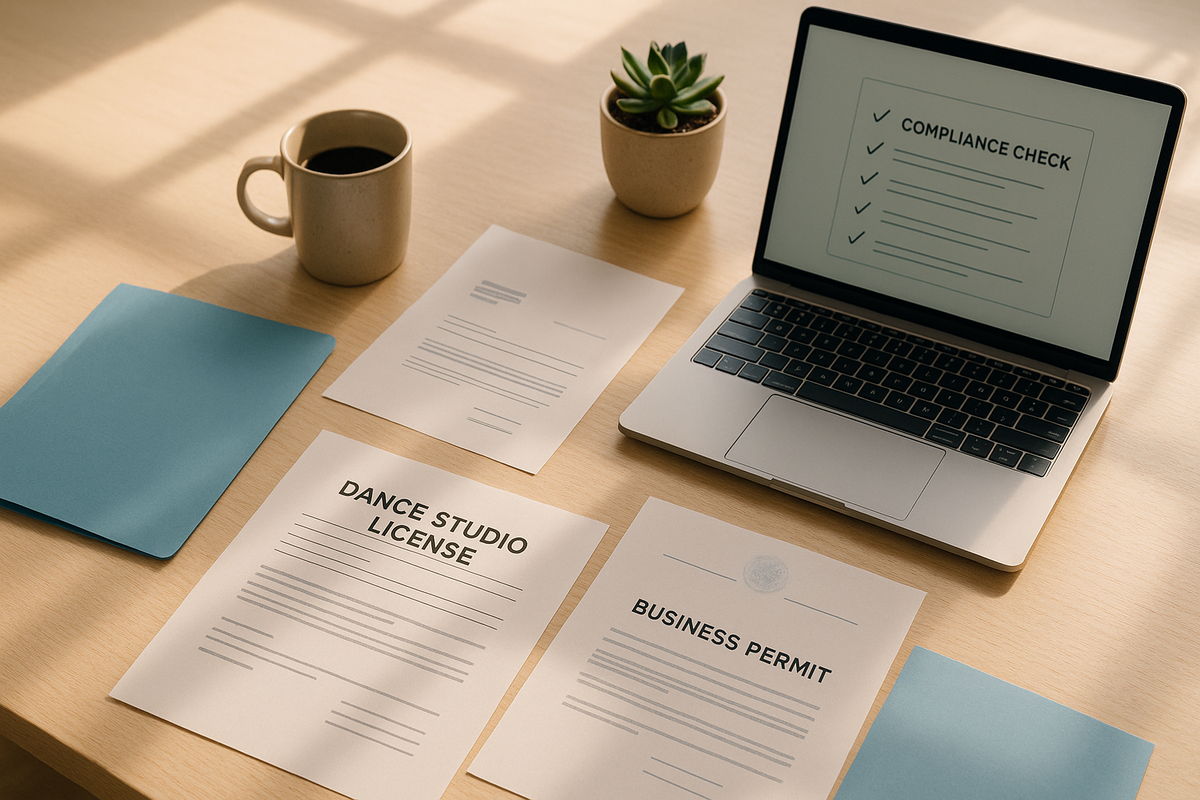
Only Florida, Michigan, and Illinois require state dance studio licenses, but assembly occupancy, zoning permits, and music licensing create complex compliance.
Key Takeaways
- State-specific dance studio licenses are required only in Florida, Michigan, and Illinois, but all studios must obtain municipal business licenses, typically costing $50–$250 annually.
- Assembly occupancy approval under the International Building Code is the most overlooked compliance requirement—dance studios are classified as Group A occupancies, triggering stricter exit, lighting, and ADA standards than retail or office spaces.
- Music licensing from ASCAP, BMI, and SESAC costs $900–$2,400 annually and is legally required before playing copyrighted music in classes; personal streaming subscriptions do not cover commercial use.
- Zoning and conditional use permits often require 60–90 days and $500–$2,000 in fees, even in commercial zones, because dance studios are classified as assembly-type occupancies in many jurisdictions.
- Child protection laws vary by state—California designates dance instructors as mandated reporters under CANRA, and most states require criminal background checks for employees with unsupervised access to minors.
- Professional liability insurance separate from general liability is essential, as instruction-related injury claims often exceed standard GL policy limits.
Where State Licensing Is Actually Required
Contrary to widespread confusion, only three states require dance-studio-specific licenses. Florida requires licensing through the Department of Agriculture and Consumer Services for businesses providing dance lessons. Michigan requires a state license from the Department of Education. In Illinois, studios must provide written contracts and obtain bonding if they collect advance payments exceeding $50 per month from any customer.
Most dance studios nationwide operate under general business licensing frameworks. After entity formation and certificate of occupancy approval, studios need a general business license from the city or county where they operate. This basic authorization, separate from zoning and building permits, typically costs $50–$250 per year and renews annually. Requirements and fees vary by municipality.
The Assembly Occupancy Trap
The most expensive mistake dance studio founders make is signing a lease before confirming the space carries the correct certificate of occupancy classification. The International Building Code classifies assembly occupancies as Group A, triggering requirements significantly stricter than standard retail (Group M) or office (Group B) spaces.
Assembly occupancy approval requires calculated occupancy load posted and enforced, illuminated exit signs above all exits, emergency lighting functional during power failures, minimum number and width of exit doors (typically one per 250 occupants), fire extinguishers at required intervals, and ADA-compliant access to restrooms and public areas. Most commercial lease spaces carry retail or office CO classifications, which are insufficient for dance instruction. Retrofitting a space after signing the lease can cost $15,000–$50,000 in unexpected build-out expenses.
Municipal Variations Add Complexity
Local regulations create a patchwork of additional requirements. Boston requires an Annual Dance School License, Certificate of Use and Occupancy, Place of Assembly Permit, and Business Certificate before opening. In Orange County, California, the Sheriff's Department regulates dance studios. The City of Waco, Texas, requires specific dance school licensing. New York City has dedicated dance studio permits beyond the standard business license.
Zoning and Conditional Use Permits
Dance studios require commercial zoning, most commonly B-1 (neighborhood commercial), B-2 (general commercial), or mixed-use designations. They are not permitted in residential zones (R-1, R-2) and generally not in industrial (I-1, I-2) zones. Even within permitted commercial zones, many jurisdictions require a Conditional Use Permit specifically for assembly-type or fitness instruction uses.
The CUP process involves formal application, public notice to neighboring property owners, and a hearing before the planning commission. It typically takes 60–90 days and costs $500–$2,000 in filing fees. Confirming both zoning eligibility and CO classification before signing a lease prevents the two most common and costly compliance failures.
Music Licensing Is Non-Negotiable
Dance studios must obtain Public Performance licenses from ASCAP, BMI, and SESAC before playing copyrighted music in classes. Personal streaming subscriptions from Spotify, Apple Music, or YouTube explicitly prohibit commercial use in their terms of service. Combined annual cost for all three performing rights organizations ranges from $900–$2,400, depending on studio size and number of locations.
These organizations employ field representatives who visit studios to verify licensing compliance. Operating without proper licenses exposes studios to statutory damages of $750–$30,000 per infringement under the Copyright Act. Music licensing requirements parallel those for yoga and Pilates studios, which face identical ASCAP and BMI obligations.
Child Protection and Background Check Requirements
Most dance studios serve minors, and state child protection mandates vary significantly. Requirements are triggered by factors including whether care is provided during school hours, whether children are left unsupervised, and whether the business is classified as a childcare facility. Most states require criminal background checks for employees with unsupervised access to minors, even in businesses not formally designated as childcare.
California's Child Abuse and Neglect Reporting Act (CANRA) designates dance instructors as mandated reporters if they interact regularly with minors. Texas requires background checks through the Department of Family and Protective Services for employees of child-care operations, depending on the nature and hours of care. Studio operators should consult local counsel to determine which statutes apply to their specific business model and schedule.
Sales Tax Registration and Treatment
A seller's permit (also called a sales tax permit or sales and use tax registration) is required from the state department of revenue before collecting payment from students. Sales tax treatment of dance instruction varies by state. Texas, New York (certain services), Florida (admission fees and some memberships), Ohio, and Minnesota generally tax dance instruction and fitness services. Other states may exempt educational instruction or apply exemptions based on the nonprofit status of the studio.
Studios must register for the permit within 15–30 days of commencing operations in most states. Penalties for operating without proper sales tax registration include retroactive tax liability, interest, and fines.
Liability Insurance Requirements
General liability insurance and professional liability (errors and omissions) coverage specific to physical instruction are essential. Standard general liability policies often exclude claims arising from professional services, including teaching. A single student injury claim alleging instruction negligence can exceed general liability policy limits, making professional liability insurance separate from general liability a critical safeguard.
If the studio hires employees, workers' compensation insurance is legally required in nearly every state. Landlords and event venues typically require a Certificate of Insurance (ACORD 25 form) listing them as additional insureds before permitting use of the space. State-specific insurance coverage requirements are part of the complex legal landscape dance studios must navigate alongside licensing obligations.
Instructor Classification: The Highest-Risk Compliance Issue
Misclassifying instructors as independent contractors instead of employees is one of the highest-risk compliance failures for dance studio owners. The IRS uses a three-category test—behavioral control, financial control, and the nature of the relationship—and most states use similar or stricter standards. California's ABC test under AB5 is particularly strict.
If the studio controls when instructors teach, what curriculum they follow, what music they use, and provides the space and equipment, the IRS and most state labor agencies will classify those instructors as employees, not contractors. Misclassification exposes studios to back payroll taxes, unemployment insurance liability, penalties, and potential wage-and-hour claims. Studios should consult an employment attorney to review their instructor agreements and payment structures.
What This Means for Studio Operators
Editorial analysis, not reported fact:
The compliance burden for dance studio operators is fragmented across state, county, and municipal layers, with no single checklist that applies nationwide. The practical implication is that founders must approach site selection and lease negotiation as compliance decisions first and location decisions second. Signing a lease before confirming zoning eligibility, CO classification, and assembly occupancy feasibility is the single most expensive mistake in the startup sequence.
A disciplined pre-lease checklist should include written confirmation from the landlord that the space holds or can obtain a Group A certificate of occupancy, verification with the municipal planning department that the address is zoned for assembly or instruction use (and whether a CUP is required), and a preliminary building inspection to estimate costs for exit signage, emergency lighting, and ADA compliance. Budget $2,000–$5,000 for professional consultation (attorney, architect, or permit expediter) during site selection—it is inexpensive insurance against $20,000–$50,000 in post-lease retrofit costs.
On the ongoing compliance side, studios should establish a compliance calendar for annual renewals: business license, music licenses (ASCAP, BMI, SESAC), liability insurance, and any state-specific bonds or registrations. Employee vs. contractor classification should be reviewed annually as the business model evolves, and any change in class schedule, service offerings, or age groups served should trigger a review of child protection, sales tax, and insurance obligations.
Sources & Further Reading
- Florida Department of Agriculture and Consumer Services, state licensing for dance studios
- Michigan Department of Education, state license requirements for dance studios
- International Code Council, International Building Code and assembly occupancy classifications
- City of Boston, dance school licensing and permit requirements
- ASCAP, music performance licensing for commercial use
- BMI, music rights and licensing
- SESAC, performance rights licensing
- California Department of Social Services, CANRA mandated reporter requirements
- Dance Studio Insurance in 2026: The Complete Guide, professional and general liability coverage
- How Much Does It Cost to Start a Yoga Studio in the US in 2026?, parallel music licensing and permit costs
- Dance Studio Franchise Boom & Adult Enrollment Trends 2026, state-specific legal requirements overview
Editorial coverage of publicly reported industry developments. Dance Studio Journal has no commercial relationship with any companies named.