Brain-Based Teaching: Feedback & Class Sequencing in Dance
How cognitive neuroscience, corrective feedback frameworks, and backward-designed curriculum are reshaping instruction in US dance studios.
Key Takeaways
- Dance learning involves multiple memory systems: sequential memory, spatial working memory, and non-declarative long-term memory, meaning effective teaching must structure progressions that align with how the brain stores and recalls movement patterns.
- Logical class structure accelerates progress: Ballet follows barre-to-center sequencing that mirrors neuromuscular warm-up needs, while commercial styles demand high-intensity openings to prepare for explosive execution; skipping these foundational sequences undermines technical development.
- Corrective feedback is the mechanism of learning: The sandwich method (positive-correction-positive), multimodal delivery (verbal, visual, kinesthetic), and specific application instructions ("plié deeper in your prep" versus "jump higher") improve retention and student confidence.
- Curriculum should work backward from end-of-year goals: Documented, progressive lesson plans that sequence learning objectives term-by-term create professional credibility with parents and allow teachers to differentiate instruction within mixed-ability classes.
- Preschool structure is a learning tool, not just behavior management: Repeated openings, consistent transitions, and recognizable routines reduce cognitive load and anxiety, enabling young children to focus on motor skill development rather than predicting what comes next.
- Teacher training now emphasizes nervous system science: How stress affects learning, somatic awareness, and accessible cueing strategies are core themes in current US professional development programs for dance instructors.
Why Brain Science Is Reshaping Dance Instruction
Dance education in the United States is undergoing a pedagogical shift as studios and teacher-training programs integrate findings from cognitive neuroscience into daily instruction. Research now clarifies that dance learning relies on sequential memory, spatial working memory, relational memory, and non-declarative long-term memory, not a single "muscle memory" process. Teachers who understand these cognitive pathways can design class progressions that match how students actually encode and retrieve movement patterns.
This represents both a professional evolution and a practical necessity. Studio owners report that parents increasingly value structured, evidence-based training over purely traditional methods, while instructors want concrete tools to accelerate student progress and reduce frustration. Creative movement serves as a model for learning and memory, visuospatial orientation, mental imagery, and multimodal sensory-motor integration, making dance an ideal context for applying neuroscience to pedagogy.
How Class Structure Mirrors Neuromuscular and Cognitive Readiness
The order in which you teach matters as much as what you teach. A traditional ballet class follows a time-tested sequence aligned with how the body needs to warm up and progress technically: each exercise builds in complexity and range of motion, warming muscles and establishing alignment. The barre stabilizes the body, teaches proper placement, and transitions naturally into center work where balance and control are tested without external support.
By contrast, commercial dance styles demand a different structure. Underneath the trends, teachers still need a strong class structure that builds foundations while allowing room for creativity and performance. Commercial classes typically start with high-intensity warm-ups, cardio-based drills, or simple choreography to build stamina and prepare the body for powerful, dynamic movement. This sets the energy for sharp execution and prepares dancers for the explosive demands of the style.
Across genres, one principle holds: don't move on to more advanced material until everyone is comfortable with the existing curriculum. Skipping foundational sequences undermines both physical readiness and cognitive encoding. A generic dance class structure typically includes a warm-up, style-specific preparation, exercises addressing physical capacities like strength and flexibility, and combinations that test knowledge, adaptability, and performance readiness in varied orientations, levels, speeds, and dynamics.
Curriculum Design That Works Backward From Performance Goals
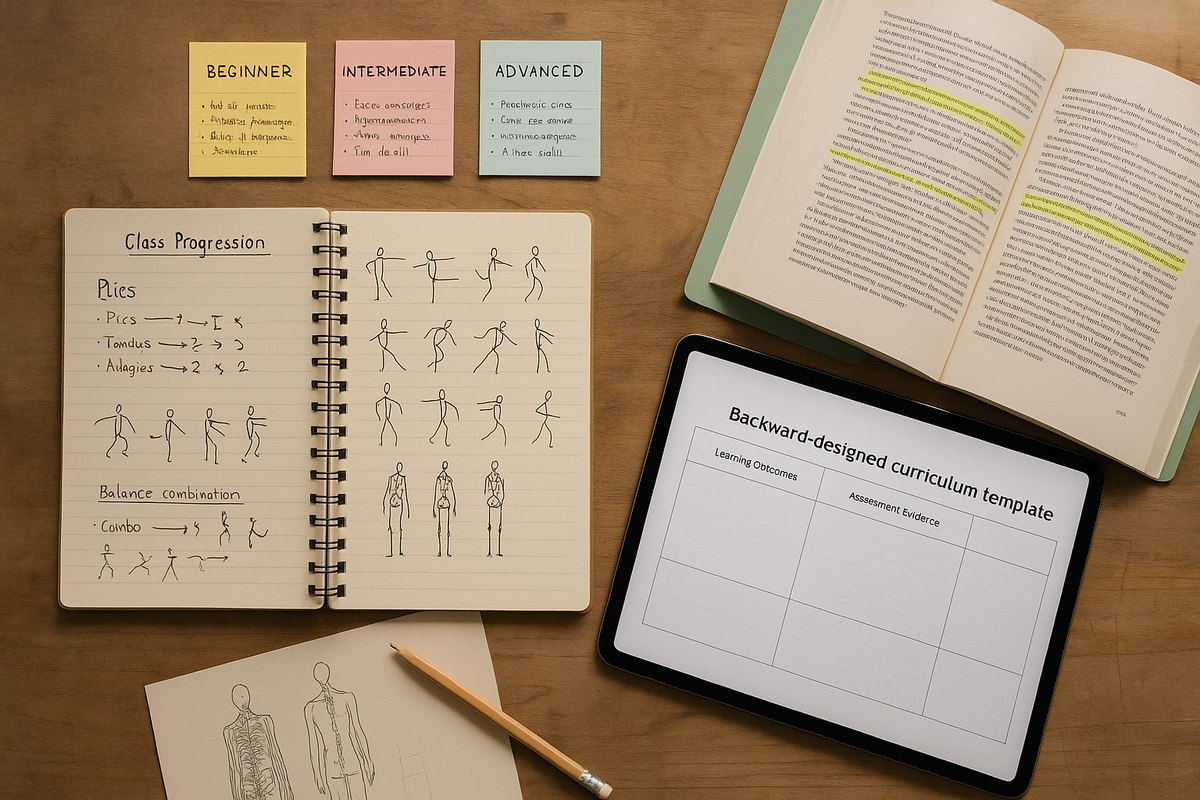
Effective curriculum planning begins at the end. Let your end-of-year vision be the starting point, and work backwards to figure out what skills, concepts, habits, and values you have to include in your dance lesson plans to get there. This becomes your class curriculum: the list of learning goals for students to meet by the end of the term. Begin by arranging your learning goals in a progressive sequence, the order in which students must learn individual steps and concepts to achieve those goals.
Documented, progressive curricula offer multiple benefits. A dance studio with a clear, documented curriculum presents a more professional image, attracting both students and parents who value structured training. Additionally, formal progress-tracking systems allow for better communication with parents about their child's development. When classes contain mixed skill levels, consider splitting the class into groups so they don't necessarily need to do the same technique or choreography. Give each group variations based on what they can do, ensuring all students experience appropriate challenge and progression.
Three Evidence-Based Feedback Frameworks Studio Teachers Are Adopting
Feedback is not optional. In dance, instructions provide information about the execution of skills, whereas feedback functions as confirmation, motivation, and guidance for the correction of mistakes. However, delivery method determines whether feedback actually improves performance. Three corrective frameworks are gaining traction in US studios:
The Sandwich Method for Sensitive Corrections
If a dancer is having a hard time receiving feedback, try the Sandwich Method: begin and end with something positive they did, and place the constructive criticism in the middle. This approach reduces defensiveness and keeps students psychologically open to improvement.
Multimodal Feedback for Different Learning Styles
There are three primary ways of conveying technical information: verbal, visual, and kinesthetic. The most common method is verbal feedback, such as telling students to turn out or point the toe. Visual demonstration and kinesthetic adjustment (hands-on correction) complete the toolkit. Though effectiveness generally holds across all three types, individuals have different processing styles. Some students are verbally oriented, others visually oriented. Dance instructors can be sensitive to these personal styles and provide the type of feedback that will best enable their students to process instructional information.
Specificity and Application Over Vague Commands
Students need actionable pathways, not just identification of errors. Rather than just pointing out what's wrong, it is important to explain how to apply the correction: If you feel they can jump higher, do they need to plié more in their prep or adjust where they're looking? What does it mean to "engage your core" and how do they do that? If a teacher tells us how to manage a certain step rather than just what the right way is, we can learn from it and we find it easier to apply the correction. Vague or oblique corrections can be disappointing and difficult, whereas phrases relating to imagery, anatomy, or the intention of terminology or style help dancers internalize changes.
Critically, receiving corrections is itself a positive signal. If you're not getting corrections from your teacher, it's not a good sign; it often means the teacher doesn't think you're ready to improve, or worse, that you're not able to improve. Framing corrections as a vote of confidence improves student psychology and retention.
Why Structure Matters Most in Preschool and Early Childhood Classes
Repeated openings, consistent transitions, and recognizable lesson patterns help children feel safe enough to try, repeat, and improve. When class segments are too long, too advanced, or disconnected, attention drops fast. Young children do better when they know what comes next. A clear class routine lowers anxiety, improves transitions, and gives teachers more time to teach instead of constantly redirecting behavior.
Progress in preschool dance usually appears in layers. The first wins are often emotional and behavioral: a child who can now sit for circle time, follow two-step directions, or wait for their turn. Technical readiness follows as children become more regulated, coordinated, and responsive to class structure. Structure is not merely behavior management; it is a cognitive scaffold that reduces processing load and allows young brains to focus on motor skill acquisition.
What This Means for Dance Studio Owners
Editorial analysis, not reported fact:
If your studio markets itself as offering quality training but your teachers cannot articulate why barre comes before center or how they sequence corrections, you have a credibility gap. Parents in 2026 are more educated about child development and learning science than any prior generation. They will notice when a class lacks structure or when feedback consists only of "do it again" without actionable steps. Investing in teacher professional development around brain-based instruction, corrective feedback frameworks, and backward-designed curriculum is no longer optional for studios seeking to retain competitive and recreational students alike.
Operationally, documented curricula make hiring easier, substitute teaching smoother, and parent communication clearer. When a new instructor joins your studio or a parent asks what their child will learn this semester, you should be able to hand them a progression map, not a vague syllabus of "ballet technique." Differentiation within classes becomes feasible when teachers understand how to scaffold progressions and offer variations, rather than teaching to the middle and losing both ends of the skill spectrum.
For preschool programs in particular, structure is your retention tool. A three-year-old who feels unsafe or confused in class will not return, regardless of how "fun" the theme was. Consistent routines, predictable transitions, and age-appropriate segment lengths build the emotional regulation that parents mistake for natural ability but is actually the product of thoughtful instructional design.
Sources & Further Reading
- National Center for Biotechnology Information: Dance and the Brain — Research on memory systems, cognitive functions, and multimodal integration in dance learning
- Ballet Above: Dance Class Structure — Overview of traditional ballet class sequencing and its neuromuscular rationale
- Dance Spirit: How to Structure a Commercial Dance Class — Contrasting structure for high-intensity, performance-focused styles
- Ballet Above: Dance Lesson Plans — Backward design and progressive sequencing for curriculum development
- Ballet Above: Dance Curriculum — Professional benefits of documented curricula and progress tracking
- Dance Advantage: Feedback in Dance Technique — Functions and modalities of corrective feedback
- Dance Spirit: 10 Things You Need to Know to Be a Better Teacher — Practical strategies for differentiation, pacing, and feedback delivery
- Dance Spirit: Constructive Criticism in Dance — Student perspectives on effective versus vague corrections, and the psychology of feedback
- Dance Spirit: Structure in Preschool Dance Class — Developmental readiness, routines, and layered progress in early childhood instruction
Editorial coverage of publicly reported industry developments. Dance Studio Journal has no commercial relationship with any companies, studios, competitions, conventions, or organizations named.